

Block I · Foundations of Knowledge & Reasoning · Day 008 / 180
Complexity & Emergence
No bird is in charge. No bird can see the shape. And yet the flock turns as one.
At dusk over Rome, a few thousand starlings pour into the sky and begin to breathe: folding, splitting, tightening into a dark fist and unspooling again into a ribbon. It looks choreographed. It looks, frankly, like something is conducting it. The measurements say otherwise. There is no conductor. Each bird appears to coordinate mainly with a small topological neighborhood, and local responses scale up into the flock-wide wave. The breathing shape exists nowhere in any individual bird’s head. It is emergent: a pattern that lives only at the level of the whole.
That gap between the simplicity of the parts and the sophistication of the pattern is today’s descent. It is one of the deepest and least settled ideas in science, and it hides a question that will stalk us for the rest of the course: when something new appears at a higher level, is it genuinely new, or just the old physics seen from far away?
Where we are
Today gives a name to a thread that has been flickering since the start of Block I. Emergence got light first touches on Day 1, where knowing was already a system-level property. Today it gets a proper definition. We lean hard on Day 7 because the day’s biggest controversy turns on whether a shiny new complexity measure is more than compression in a lab coat. And we reuse Day 5 because the hardest version of emergence is a claim about downward causation: the whole reaching back down to push its parts around.
The phenomenon
Six or seven neighbors, and nothing else
Start with what we actually know, in the careful Day 1 sense. In the mid-2000s, the STARFLAG project put stereoscopic cameras on a rooftop museum in Rome, photographed real starling flocks of up to 2,700 birds, and reconstructed the 3-D position of every single one. Then they asked a deceptively simple question: when a bird adjusts to its neighbors, which neighbors?
The intuitive answer is metric: a bird reacts to everyone within, say, three meters. The data said no. STARFLAG inferred that interaction was organized mainly by neighbor rank, with an effective range of roughly six or seven nearest neighbors, rather than by a fixed metric radius. Pack the flock tighter and the same topological rule can still operate; spread it out and the effective metric distance changes. The interaction is topological, not metric: it counts neighbors, not meters.
“Each bird interacts on average with a fixed number of neighbors (six to seven), rather than with all neighbors within a fixed metric distance.”
Why does this matter? The STARFLAG authors argued that a topological rule is exactly what you would want if the group must stay coherent as density changes. When a predator compresses part of a flock, a fixed-radius rule would change the number of neighbors tracked; a nearest-neighbor rule is more robust. And it is still local. No bird knows the flock’s shape. No bird is solving for the global pattern. The pattern is a side effect of thousands of birds each minding a tiny neighborhood.
Interactive · order from local rules
The Murmuration Engine
Every dot is a boid, a simulated bird obeying up to three local rules. Turn all three off and you get a gas; switch them on one at a time and watch a flock condense out of the chaos. The alignment meter reads how unified the headings are. Nothing in the code ever mentions flock.
alignment 0.00
Flocking rules
The table summarizes three local rules. Without them, motion is gas-like; with separation, alignment, and cohesion active, order appears as a high alignment score.
| Rule | Local instruction | System effect |
|---|---|---|
| Separation | Steer away from neighbors who get too close. | Prevents collisions and keeps individuals distinct. |
| Alignment | Match the average heading of nearby birds. | Lets the group turn as one. |
| Cohesion | Drift toward the local center of mass. | Keeps the flock from evaporating. |
| Nearest-neighbor count | Track about six or seven neighbors, not a radius. | Preserves cohesion when density changes. |
The model
Three rules, written in 1986
The simulation is essentially Boids, built by Craig Reynolds in 1986 and presented at SIGGRAPH in 1987. Reynolds wanted realistic flocking for animation and discovered he needed three local rules: separation (do not crowd), alignment (steer with neighbors), and cohesion (stay with the group). From those three, the repertoire of flocking falls out: wheeling, splitting around obstacles, fluidly merging again. Boids has since flocked movie bats and countless digital armies. It is the canonical demonstration that complex global behavior need not have a complex global cause.
And Boids is one specimen of the same trick: simple parts, surprising wholes.
- Ant colonies find short paths to food with no surveyor and no map. Each ant lays a chemical trail and follows others’ trails; shorter routes get reinforced faster. Biologists call this stigmergy: coordination through traces left in the environment rather than direct command.
- A pot of water can spontaneously organize itself. Heat it from below and, past a threshold, smooth liquid breaks into ordered convection cells: structure sustained by energy flow, a preview of the physics-of-life arc on Days 83-85.
- Your brain is reading this sentence with no homunculus inside doing the reading. Meaning emerges from neurons that individually understand nothing, the steep version of the puzzle we return to on Days 123-126.
When the parts compute
The maddening case of the slime mold
If the murmuration is emergence as beauty, slime mold is emergence as intelligence arising in something with no brain. Physarum polycephalum is a single giant cell, a sprawling yellow blob with protoplasm and an appetite for oats.
In 2010, a team led by Toshiyuki Nakagaki and Atsushi Tero laid out oat flakes in the geographic pattern of Tokyo and 35 surrounding towns, then dropped a slime mold on Tokyo. The blob spread out to engulf the food, then pruned itself. Redundant tubes withered; efficient ones thickened. Within about a day it had sculpted a network similar in total length, efficiency, and fault tolerance to the actual Tokyo rail system.
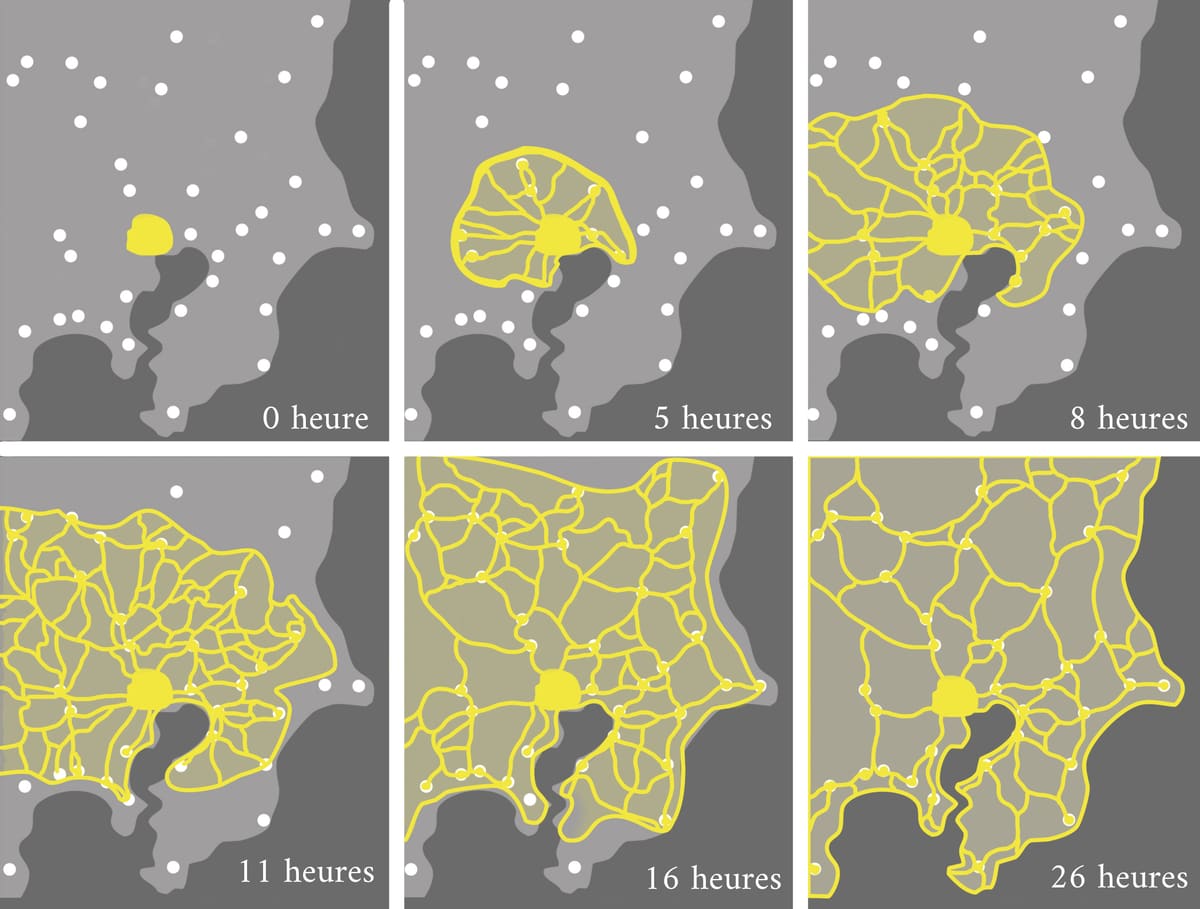
Physarum polycephalum expands through local growth and pruning, turning scattered food points into a branching transport network.
The model “quantitatively mimics phenomena that can be neither captured nor quantified by verbal description alone.”
The slime mold is not clever, and it is not literally executing the simplified model as an algorithm. The plasmodium’s growth and pruning dynamics converge on an efficient transport network without explicitly representing the planning problem. The blob designs a railway it cannot conceive of. The computation lives in the interactions, not in a central planner.
A useful warning
It is tempting to narrate all this as the parts being secretly smart. Resist it. The payoff of emergence is that the parts can be as simple as they look. The sophistication is manufactured by organization: by the pattern of who affects whom. That is also why emergence is seductive to overclaim. Once you accept that simple rules can yield astonishing wholes, it is a short step to declaring that your favorite simple rule explains everything.
The model, sharpened
The phrase that launched a field
For a long time, emergence was a word physicists said with suspicion: vague, faintly mystical, the sort of thing you invoked when you lacked equations. Then in 1972, the condensed-matter physicist Philip W. Anderson published a short essay in Science with a title that became a slogan: “More Is Different.”
Anderson accepted reductionism as a claim about fundamental laws. His target was constructionism: the stronger assumption that knowing those laws is sufficient to reconstruct every higher-level science. He granted the first, then drove a wedge through its smug corollary.
“The ability to reduce everything to simple fundamental laws does not imply the ability to start from those laws and reconstruct the universe… at each level of complexity entirely new properties appear.”
Knowing how two water molecules interact does not hand you wetness, fluidity, convection cells, or the exact way a tsunami breaks. Those are real, lawful properties of collectives. New levels of organization have their own rules, concepts, and sciences. Chemistry is not merely physics in inconvenient notation; biology is not merely chemistry with extra vocabulary. Each level is emergent from the one below and yet, in a meaningful sense, autonomous from it.
The debate
Weak vs. strong: the fault line
Murmurations and slime molds are standard examples under broad weak-emergence usage. The fight is over what that word is allowed to mean.
Weak emergence: the scientist’s version
The philosopher Mark Bedau gave the careful account most working scientists can use. Under his influential formulation, a macro-pattern is weakly emergent when it follows from the micro-rules and specified conditions, but obtaining it requires running or effectively simulating those rules. The murmuration is weakly emergent in that sense. The three Boids rules alone do not spit out tomorrow’s flock shape; you also need the initial state, boundaries, and a run of the dynamics. Crucially, weak emergence is not spooky. It is fully grounded in the parts and their interactions.
Strong emergence: the radical version
A property is strongly emergent if facts about the whole are in principle not deducible from complete lower-level truths and laws. The point is not merely that computation is expensive; it is that the high level would require genuinely new facts or laws, possibly including downward causation. David Chalmers argues that there may be exactly one candidate for strong emergence in nature: consciousness. Everything else looks weakly emergent: surprising, irreducible in practice, but not irreducible in principle.
Why not embrace strong emergence everywhere? Because it collides with Jaegwon Kim’s causal exclusion problem. Suppose a high-level state causes a physical effect. But that effect already has a complete physical cause at the level of parts. Strong emergence must relax physical causal closure, accept systematic causal overdetermination, or deny that macro-properties possess independent causal efficacy. Defenders have answers, but no knockout. This is why the strong/weak line remains live under biology, mind, and social systems.
Interactive · computation from a two-rule universe
Conway's Game of Life, and the gun that fires forever
A grid of cells, each alive or dead, updates on two rules about live neighbors. From this tiny rulebook come gliders, oscillators, and the famous Gosper glider gun below: a finite pattern that spits out a glider forever. This toy universe is Turing-complete.
The entire rulebook
- A live cell with 2 or 3 live neighbors survives.
- A dead cell with exactly 3 live neighbors is born.
- Everything else dies or stays dead.
Click a cell, or focus the grid and use the arrow keys to choose one; press Space or Enter to toggle it. Generation 0.
Conway’s Game of Life and glider gun · example
Conway’s Game of Life is a grid of live and dead cells; each cell updates only from the state of its eight neighbors. These minimal rules can produce gliders, oscillators, and the Gosper glider gun, a finite pattern that keeps emitting gliders. The important lesson is not the animation but the absence of a universal shortcut: many starting patterns must be run to reveal their fate, although many others can be analyzed directly.
| Cell state | Neighbor count | Next state |
|---|---|---|
| Alive | 2 or 3 live neighbors | Survives |
| Alive | 0, 1, 4, 5, 6, 7, or 8 live neighbors | Dies |
| Dead | Exactly 3 live neighbors | Becomes alive |
| Dead | Any other live-neighbor count | Stays dead |
Sit with what the Game of Life proves. Two rules, applied to a grid, are enough to build logic gates, memory, clocks, and a universal computer. The “computer” is nowhere in the rules; it is a pattern in the cells. This is the cleanest illustration of weak emergence: there is no general algorithm that decides every long-term question about arbitrary Life configurations, although many particular patterns can be analyzed without exhaustive simulation. Simple law, unboundedly complex behavior, no universal shortcut.
A necessary detour
Nobody can agree how to measure “complex”
Here is an embarrassing secret of complexity science: there is no single agreed definition of complexity. Seth Lloyd once compiled a famous list of dozens of proposed measures, and they do not agree with each other. This is not mere sloppiness. “Complex” is doing several jobs at once: how hard is it to describe, how hard is it to build, and how organized is it?
That last family hides the key teaching heuristic. The most interesting complex systems are usually not the most random ones. Consider a crystal, a living cell, and a canister of gas. By a pure “hard to describe” measure, the gas wins because perfect randomness needs the longest description. But that does not make a gas biologically or organizationally more complex than a cell. A crystal is too ordered; a gas is too disordered. Many useful complexity measures peak somewhere in the structured, surprising, neither-frozen-nor-random middle, though not every formal measure has the same hump.
Diagram · the complexity-entropy hump
Disorder runs left to right: perfect order on the left, perfect randomness on the right. The curve is a teaching sketch for effective complexity, not a theorem for every complexity measure. It collapses at both extremes and peaks in the organized middle where life, language, and minds live.
Murray Gell-Mann’s effective complexity tries to measure the regularities of a thing while throwing away the purely random part. Keep this hump as a heuristic: the Assembly Theory fight is partly about whether a new metric has captured organized structure, or smuggled “hard to describe” back in under a new name.
The frontier · 2026
Three live edges, and the hype filter at full stretch
Emergence is where some of the boldest and most overhyped claims in current science live. Today’s frontier contains a genuine, bruising fight in the peer-reviewed literature.
Assembly Theory: a complexity ruler, or a theory of everything?
In 2023, a group led by Leroy Cronin and Sara Walker published a Nature paper titled “Assembly theory explains and quantifies selection and evolution.” The core idea is clever. Take an object, such as a molecule, and ask: what is the minimum number of steps to build it from basic parts, if you can reuse any piece already made? That number is the assembly index. In practice, experimental papers estimate or infer this index from spectra rather than exhaustively proving the exact minimum path. Pair it with copy number, and Assembly Theory claims to detect the fingerprint of a process that selects and reproduces structures. The killer application is astrobiology: proponents report that molecules with assembly index above roughly 15 are extremely unlikely to form abiotically in their tested settings.
What is solid here is genuinely solid. The assembly index is a real molecular-complexity quantity, but experimental papers operationally estimate or infer it from fragmentation and spectroscopic evidence rather than reading off an instrument-independent exact minimum. A 2024 ACS Central Science paper showed estimates from mass spectrometry, NMR, and infrared spectroscopy can agree. It separates many biological from abiotic samples in the lab.
The trouble is everything stacked on top. The grander claims that Assembly Theory explains selection, evolution, time, and the physics-biology bridge drew fierce backlash. A 2024 PLOS Complex Systems analysis by Abrahão, Zenil, and colleagues argued that the assembly index is mathematically an approximation to standard data compression and cannot outperform Shannon entropy for the job it claims. Other critiques attacked the biosignature classification and the evolutionary claims.
Cronin and Walker have pushed back. Their defense is the crux: compression measures statistical redundancy in strings, they argue, while assembly index is about physical causal history: the minimal path by which a real object could be built in the world, tied to how many copies exist. Whether that distinction is deep or cosmetic is exactly what remains unsettled. Verdict: the ruler is real; the theory-of-everything claims are not established.
| Assembly Theory claim | Hype-filter status |
|---|---|
| The assembly index is a measurable molecular-complexity metric. | Established |
| Index above about 15 is reported by proponents as a possible threshold in particular datasets and implementations. | Promising hint |
| It explains and quantifies selection and evolution in a way biology recognizes. | Contested |
| It is fundamentally novel versus compression, Kolmogorov complexity, and Shannon entropy. | Contested |
Self-organized criticality: the sandpile that tunes itself
In 1987, Per Bak, Chao Tang, and Kurt Wiesenfeld proposed a mesmerizing idea: some systems drive themselves to the knife-edge of a phase transition with no external tuning. Their model was a sandpile. Drop grains one at a time and the pile steepens until avalanches of all sizes keep it near a critical slope. This self-organized criticality became a candidate explanation for earthquakes, forest fires, extinctions, market crashes, and 1/f noise.
SOC is real: sandpile-type models do self-organize to criticality. But the grand claim that SOC is the universal engine of complexity has not held up. The most hyped application, the “critical brain” hypothesis, remains contested. A beautiful mechanism was oversold as a theory of everything.
Can you put a number on emergence itself?
The newest frontier tries to move weak versus strong emergence from armchair debate into mathematics. Erik Hoel and colleagues developed causal emergence, using effective information to show that a macro-scale model can sometimes carry more causal information than the micro-scale model it is built from. Fernando Rosas, Pedro Mediano, and colleagues use information decomposition to test whether a macro feature predicts a system’s future better than any individual part can.
This is careful, fertile work, so it earns “promising.” The caveat is interpretation. Critics argue these measures may capture epistemic emergence, about our best models and descriptions, rather than the ontological strong emergence philosophers mean. The math is landing; what it measures is still under debate.
Open questions
What’s genuinely unsettled
- Is strong emergence real anywhere? Or is everything weakly emergent, surprising but reducible, with Kim’s exclusion argument quietly winning?
- Is downward causation a real force or a figure of speech? Can a whole genuinely push its parts around in a way the micro-laws do not already determine?
- Is there one principled measure of complexity? Or will we always have a drawer full of measures, each right for a different job?
- Does Assembly Theory carve nature at a new joint? Or is it useful compression and information theory wrapped in bigger claims than it can cash?
- What about AI emergence? When a large language model seems to gain a new skill at scale, is that genuine emergence or an artifact of the metric? Hold that thought for Day 139.
The day in three sentences
- Big idea
- Simple parts following local rules can generate global order with no leader and no blueprint. “More is different” names the fact that higher levels can have real patterns and laws of their own.
- Best analogy
- The murmuration that breathes though no bird sees its shape, and the slime mold that computes a railway it cannot understand.
- Live controversy
- Assembly Theory is a real molecular-complexity ruler, but its claims to explain selection, evolution, and time remain contested.
Threads today › emergence gets its proper definition · information returns as compression and assembly index · computation appears in Game of Life · energy flow hints toward life.
Sources
Sources & further reading
- Ballerini, M., Cabibbo, N., Candelier, R., et al. (2008). “Interaction ruling animal collective behavior depends on topological rather than metric distance.” PNAS 105(4): 1232-1237. doi:10.1073/pnas.0711437105.
- Cavagna, A., Cimarelli, A., Giardina, I., et al. (2010). “Scale-free correlations in starling flocks.” PNAS 107(26): 11865-11870.
- Reynolds, C. W. (1987). “Flocks, Herds, and Schools: A Distributed Behavioral Model.” Computer Graphics 21(4): 25-34.
- Anderson, P. W. (1972). “More Is Different.” Science 177(4047): 393-396. doi:10.1126/science.177.4047.393.
- Tero, A., Takagi, S., Saigusa, T., et al. (2010). “Rules for Biologically Inspired Adaptive Network Design.” Science 327(5964): 439-442. doi:10.1126/science.1177894.
- Marwan, W. (2010). “Amoeba-Inspired Network Design.” Science 327(5964): 419-420. doi:10.1126/science.1185570.
- Gardner, M. (1970). “Mathematical Games: The fantastic combinations of John Conway’s new solitaire game ‘life’.” Scientific American 223(4): 120-123.
- Rendell, P. (2011). “A Universal Turing Machine in Conway’s Game of Life.” In 2011 International Conference on High Performance Computing & Simulation, 764-772. doi:10.1109/HPCSim.2011.5999906.
- Izhikevich, E. M., Conway, J. H., and Seth, A. (2015). “Game of Life.” Scholarpedia 10(6): 1816. doi:10.4249/scholarpedia.1816.
- Bedau, M. A. (1997). “Weak Emergence.” Philosophical Perspectives 11: 375-399.
- Chalmers, D. J. (2006). “Strong and Weak Emergence.” In The Re-Emergence of Emergence, Oxford University Press.
- Kim, J. (1999). “Making Sense of Emergence.” Philosophical Studies 95: 3-36.
- Bak, P., Tang, C., and Wiesenfeld, K. (1987). “Self-organized criticality.” Physical Review Letters 59(4): 381-384. doi:10.1103/PhysRevLett.59.381.
- Bonachela, J. A., et al. (2010). “Self-organization without conservation: are neuronal avalanches generically critical?” J. Stat. Mech. P02015. arXiv:1001.3256.
- Sharma, A., Czégel, D., Lachmann, M., Kempes, C. P., Walker, S. I., and Cronin, L. (2023). “Assembly theory explains and quantifies selection and evolution.” Nature 622: 321-328. doi:10.1038/s41586-023-06600-9.
- Marshall, S. M., Mathis, C., Carrick, E., et al. (2021). “Identifying molecules as biosignatures with assembly theory and mass spectrometry.” Nature Communications 12: 3033.
- Jirasek, M., Sharma, A., Bame, J. R., et al. (2024). “Investigating and Quantifying Molecular Complexity Using Assembly Theory and Spectroscopy.” ACS Central Science 10(5): 1054-1064.
- Abrahão, F. S., Hernández-Orozco, S., Kiani, N. A., Tegnér, J., and Zenil, H. (2024). “Assembly Theory is an approximation to algorithmic complexity based on LZ compression that does not explain selection or evolution.” PLOS Complex Systems 1(1): e0000014.
- Uthamacumaran, A., Abrahão, F. S., Kiani, N. A., and Zenil, H. (2024). “On the salient limitations of the methods of assembly theory and their classification of molecular biosignatures.” npj Systems Biology and Applications 10: 82.
- Jaeger, J. (2024). “Assembly Theory: What It Does and What It Does Not Do.” Journal of Molecular Evolution 92: 87-92.
- Walker, S. I., Mathis, C., Marshall, S. M., and Cronin, L. (2024). “Experimentally measured assembly indices are required to determine the threshold for life.” Journal of the Royal Society Interface 21(220): 20240367.
- Hazen, R. M., Burns, P. C., Cleaves, H. J. II, and Wong, M. L. (2024). “Reply to ‘Experimental measurement of assembly indices are required to determine the threshold for life’.” Journal of the Royal Society Interface 21(220): 20240622.
- Gell-Mann, M., and Lloyd, S. (1996). “Information measures, effective complexity, and total information.” Complexity 2(1): 44-52.
- Hoel, E. P., Albantakis, L., and Tononi, G. (2013). “Quantifying causal emergence shows that macro can beat micro.” PNAS 110(49): 19790-19795.
- Rosas, F. E., Mediano, P. A. M., Jensen, H. J., et al. (2020). “Reconciling emergences: An information-theoretic approach to identify causal emergence in multivariate data.” PLOS Computational Biology 16(12): e1008289.
- Dewhurst, J. (2021). “Causal emergence from effective information: Neither causal nor emergent?” Thought 10(3): 158-168.
- Schaeffer, R., Miranda, B., and Koyejo, S. (2023). “Are Emergent Abilities of Large Language Models a Mirage?” NeurIPS 2023.
Deep dive appendixThe Deeper Machinery of EmergenceOptional extension.
The main descent gave you the headline idea — more is different — and the one fight everyone’s having about it (Assembly Theory). But emergence is one of those subjects where the best material is in the second drawer down: the precise mathematics of why phase transitions provide some of the cleanest controlled examples of wholes exceeding their parts, the eerie little programs that turn a single line of cells into chaos or a printing press, the question of where exactly a system has to sit to be capable of interesting behavior at all, and the surprisingly deep problem of saying what “complex” even means when “hard to describe” already failed us. This appendix is that drawer. It runs continuously from where we left off — same instinct throughout: the interesting behavior lives between the parts, not inside them.
↩ Picking up the thread
In the main lesson we built emergence from the bottom up — local rules (Boids, ant stigmergy) → universal computation you can watch (Conway’s Life) → the weak/strong fault line (Bedau vs. Chalmers, with Kim’s exclusion argument lurking) → the warning that “complex ≠ hard to describe” (the entropy hump) → the hype filter at full stretch on Assembly Theory and self-organized criticality. Everything below assumes all of that and goes further into the parts we only gestured at. Nothing here repeats it.
§1 · the physicist’s emergence
Phase transitions: the whole, with exact equations
When a philosopher wants to argue about emergence, they reach for consciousness. When a physicist wants to, they reach for a pot of water crossing a phase boundary — because here, uniquely, emergence comes with airtight mathematics and you can prove the strange thing is real. At one atmosphere, equilibrium water is liquid just above 0°C and ice just below it. In a large enough sample the change can look like a cliff. The forces between any two water molecules don’t change one bit as you cross zero. So where does the cliff come from?
The answer is that a mathematically sharp phase transition is a property of the collective — in the standard canonical definition, the exact singularity appears only in the thermodynamic limit, as the number of particles goes to infinity. Finite systems can still melt, freeze, and show rounded transitions, pseudocritical peaks, and finite-size signatures. What they do not have is the infinitely sharp nonanalyticity of the textbook ideal. “Solid” and “liquid” are not facts about isolated molecules; they are facts about arrangements of many molecules. This is Anderson’s “more is different” stated with theorems instead of slogans: a new, lawful, predictable collective property that cannot be read off any individual part. established
The miracle of universality
Now the part that made physicists fall out of their chairs in the 1970s. Some phase boundaries terminate at a critical point — a precise temperature and pressure where the distinction between two phases is about to vanish — and the system fluctuates at every scale at once: tiny droplets inside bigger droplets inside bigger ones, with no characteristic size. Fluids near their liquid-gas critical point do it; magnets do something analogous near the Curie point; even some models of neural tissue borrow the same language. And here is the shock: systems in the same universality class can share critical exponents and scaling functions after suitable rescaling. A fluid near its liquid-gas critical point and a magnet near its Curie point can share the same critical exponents despite their completely different microscopic constituents.
Paraphrasing the Kadanoff-Wilson-Fisher tradition: near a critical point, many microscopic details stop mattering. What survives is symmetry, dimension, order-parameter structure, interaction range, and only a few other relevant features.
This is called universality, and systems that share the same critical behavior form a universality class. It is arguably the most profound thing emergence has taught us, because it says the macroscopic world is sometimes allowed to forget many microscopic details. Which details survive depends on properties such as dimensionality, symmetry, order-parameter structure, and interaction range; for dynamic critical behavior, conservation laws and slow modes matter too. Kenneth Wilson won the 1982 Nobel Prize for the renormalization group, the machinery that explains exactly why: as you “zoom out” and average over finer details, irrelevant features wash away and only a few survive. Universality is one reason higher-level sciences can have useful autonomous laws. It is not a blanket proof that every field is screened off from lower-level physics in exactly the same way. established — Nobel 1982
Why this is the keystone of the whole topic
Hold universality next to the main lesson’s argument about Assembly Theory. The reason “is the assembly index just compression?” is a hard question is that emergence genuinely can make high-level descriptions autonomous in practice — a phase transition really is a new thing with its own laws, not a bookkeeping trick. Universality is an existence proof that some level autonomy is real, not hand-waving. The open question is whether this particular proposed high-level law carves nature at a joint, or is a re-description of the parts. That’s the entire game, and §1 is why it’s worth playing.
§2 · the tipping point you can draw
Percolation: how a forest decides to burn
The phase transition in §1 is profound but abstract. Percolation is its baby cousin, and it’s so simple you can hold it in your hand. Picture a grid. Independently, with probability p, fill each cell (a tree in a forest; a conducting grain in a film; an open pore in a rock). Now ask one question: does a connected cluster of filled cells span the whole grid, edge to edge?
For small p you get scattered little islands — nothing reaches across. Crank p up slowly and the islands grow and merge, still local, still finite… and then, near a critical threshold pc, a giant cluster becomes overwhelmingly likely and stitches one side of the world to the other. In an infinite 2-D square lattice the transition is sharp, with pc ≈ 0.5927 for independent site percolation. In any finite grid, the curve is rounded: sometimes a spanning cluster appears below the threshold, sometimes it fails above it. The lesson is still emergent and global, but the mathematical cliff belongs to the infinite ideal. The example below follows this threshold:
Interactive · the percolation threshold
When does a forest become one connected path?
Drag the density slider. Each site is independently filled with probability p. Teal marks a cluster that spans from top to bottom; near p ≈ 0.59 the finite grid's probability curve steepens, but it is not the exact cliff of the infinite ideal.
fill probability
0.59 near critical
filled sites 0 · largest cluster 0
Finite grids are noisy: a sample can span below the threshold or fail above it. The mathematically sharp transition belongs to the infinite system.
Figure · The Percolation Threshold
The grid uses representative densities. Each cell is filled independently with probability p, and a spanning cluster is one that touches both the top and bottom edges. Near p ≈ 0.59, the finite grid’s probability curve steepens — a few percentage points of density can separate scattered islands from a connected continent, though the exact cliff belongs to the infinite ideal.
Two things make percolation worth its own section. First, it is the minimal model of one kind of tipping point — a useful skeleton for forest fires, epidemics, rumors, porous rock, and conducting films when the assumptions fit. Those systems have extra physics, behavior, and correlations, so percolation is a model, not the hidden identity of everything. (This is the exact instinct we carry into Day 9, where tipping points get their own deep dive, and Day 12, where the grid becomes a network.) Second — and this is the payoff of §1 — percolation sits in its own universality class. The way the giant cluster emerges near pc follows power laws with exponents that can be shared across different microscopic settings. The threshold value pc depends on the lattice; the critical behavior around it is universal within the class. established
§3 · programs that shouldn’t be able to do that
One line of cells, four destinies
Conway’s Game of Life (main lesson) is a two-dimensional cellular automaton, and a famously rich one. But in the 1980s Stephen Wolfram asked a deceptively dull question: what’s the simplest cellular automaton that still does something interesting? He stripped it down to a single row of cells, each black or white, updating in discrete steps. Each cell looks only at itself and its two immediate neighbors — three cells, eight possible patterns — and a “rule” is just a choice of new color for each of those eight cases. That’s 2⁸ = 256 possible rules, the whole universe of them, each numbered 0–255. You cannot invent a much simpler computational system. And yet Wolfram found that these toy programs often sort into four qualitative classes — an influential taxonomy that echoes across complex systems, even though classification can be ambiguous and the four buckets are not a rigorous exhaustive theorem:
- Class 1 — Death. Everything collapses to a single uniform state. All structure erased. (The analogue of a crystal freezing, or a system falling into one fixed point.)
- Class 2 — Frozen order. Settles into stable or simply-repeating local patterns. Predictable forever. (Periodic, dull, safe.)
- Class 3 — Chaos. Produces aperiodic, random-looking noise with no persistent structure — like Rule 30. (The analogue of a gas; high entropy.)
- Class 4 — The interesting one. Neither frozen nor random: localized structures that move, persist, collide, and interact — like Rule 110. This is the edge between order and chaos, and it’s where computation lives.
That last class is the prize. Wolfram conjectured, and Matthew Cook later proved (work circulated from the 1990s, published 2004), that Rule 110 — a one-line, three-neighbor toy you could code in a tweet — is Turing-complete. A single row of cells flipping by the dumbest imaginable rule can, in principle, compute anything any computer can compute. Let that land: universal computation does not require complicated hardware. It can emerge from very nearly nothing. Meanwhile Rule 30, from the very same 256, produces such high-quality randomness from its simple deterministic rule that Wolfram’s software used it for years as a pseudorandom generator. Its central column has been studied as a pseudorandom source, although that is not the same as established cryptographic security. Same rulebook size, same three-cell neighborhood — one rule computes, one rule is chaos, one rule dies. Run them yourself:
Interactive · elementary automata
Rule 30, Rule 110, and friends
Each row down the screen is one time step. By default we start from a single black cell at the top center and let the three-cell rule paint history downward. Switch between famous rules and compare chaos, universal computation, fractals, traffic flow, and frozen order from the same tiny rulebook.
Figure · Rule 30, Rule 110, and friends
The figure draws elementary cellular automata downward in time from either one central black cell or a random first row. Rule 30 produces chaotic-looking texture, Rule 110 supports universal computation, Rule 90 draws the Sierpiński triangle, Rule 184 resembles traffic flow, and Rule 250 settles into simple order.
Wolfram packaged all this into a thousand-page book, A New Kind of Science (2002), with a sweeping thesis: simple programs are the right language for nature, and complex behavior is cheap and everywhere rather than rare and hard-won. The empirical core — that trivial rules generate Class-4 complexity and that Rule 110 is universal — is rock solid and genuinely important. established The grander framing — his “Principle of Computational Equivalence,” the claim that almost all non-trivial systems are maximally, equivalently computational, and that this reorganizes all of science — was received frostily by many scientists as overclaiming and under-crediting predecessors. contested/hype The lesson rhymes with the main tour: a real and beautiful result, oversold into a theory of everything.
§4 · where interesting things are allowed to happen
The edge of chaos & order for free
Notice that Wolfram’s Class 4 — the computing class — sits between frozen order (Class 2) and chaos (Class 3). That positioning inspired one of complexity science’s most influential hypotheses: the edge of chaos. The intuition, developed by Chris Langton, Norman Packard, and others at the Santa Fe Institute in the late 1980s, is that systems capable of rich behavior — computation, life, adaptation — often benefit from a regime near the boundary between rigid stability and runaway turbulence. Too ordered and nothing ever changes (no new information). Too chaotic and nothing ever persists (no memory). Near the edge, a system can store structure and transform it. The strong claim that computation or life can exist only there remains debated.
The most beautiful demonstration came from the theoretical biologist Stuart Kauffman, and it’s the antidote to a lazy assumption people make about biology — that all of life’s order had to be painstakingly built by natural selection, fought for gene by gene. Kauffman asked: what does a random network of interacting genes do, with no selection at all? He modeled it as a random Boolean network — N genes (nodes), each switching on or off based on inputs from K others, with the wiring and the rules chosen completely at random. Pure chaos, you’d guess. Instead, he found something startling:
Paraphrasing Kauffman’s random-Boolean-network argument: order can arise for free. Even randomly assembled networks can fall spontaneously into stable, repeating patterns, without careful tuning, design, or selection.
The crucial finding is an order-chaos transition controlled by connectivity K. In the classic unbiased random Boolean ensemble, small perturbations typically shrink below K ≈ 2 and spread above it. Low-K networks tend toward frozen or simple attractors; high-K networks are sensitive and chaotic-looking. But every finite deterministic Boolean network still eventually enters an attractor — either a fixed point or a cycle. Right around the critical regime, the network can be both robust to small knocks and capable of switching. Kauffman’s bold interpretation: those attractors are like cell types. An organism’s genome is one wiring; its different cell types (neuron, liver, skin — same DNA, different stable expression patterns, a puzzle we’ll meet again on Day 95) might be the different attractors the gene network falls into. Some of biology’s order, he argued, might be “order for free” — a generic property of networks near the edge, that selection then tunes rather than creates from scratch. Tune K yourself and watch the regimes:
Interactive · order, the edge, and chaos
A random Boolean network finding its footing
A grid of nodes, each ON or OFF, updates from K randomly wired inputs by random rules. The activity trace shows what fraction of nodes flip each step. Low K tends to freeze, high K stays noisy, and near K ≈ 2 the network often settles into structured low-level activity.
regime —
current flip rate 0%
Figure · A Random Boolean Network Finding Its Footing
A grid of nodes, each ON or OFF, updates from K randomly wired inputs by random Boolean rules. The activity trace shows what fraction of nodes flip each step. Low K tends to flatten into frozen order; high K stays noisy; around K = 2 the network often enters structured low-level activity near the edge of chaos.
How does this hold up in 2026? The mathematical core is solid: random Boolean networks really do exhibit an order–chaos transition near a critical connectivity, and “order for free” is a genuine, reproducible phenomenon. established as mathematics The biological claim — that this is a major source of real organismal order, rivaling selection — remains a minority and contested position; mainstream evolutionary biology still puts selection front and center, and treats Kauffman’s attractors-as-cell-types as a suggestive analogy rather than an established mechanism. And the strongest version of the “edge of chaos” slogan — that life and computation must sit exactly at criticality — is itself contested, the same family of overclaim as the “critical brain” we met in the main lesson. The calibrated summary: a real and influential regime, an inspiring hypothesis about its reach, and a frontier still arguing about how far it actually extends.
§5 · the ruler problem, in full
The complexity zoo: every measure we tried
The main lesson dropped a bombshell and moved on: there is no single agreed measure of complexity, and the “hardest to describe” measure embarrassingly crowns a canister of gas as the most complex thing in the room. The entropy hump fixed the worst of that by measuring only the regularities. But that’s just one entry in a genuine menagerie. It’s worth meeting the others, because each one is trying to capture a different true intuition about what “complex” means — and the fact that they disagree is itself the lesson.
- Kolmogorov complexity The length of the shortest program that outputs the object. The purest “difficulty of description.” Fatally, it is uncomputable — no algorithm can find it in general (a cousin of the halting problem, Day 27 ) — and it calls random noise maximally complex, which clashes with intuition. The foundation everything else reacts against. established
- Logical depth Charles Bennett’s fix: complexity is not just the size of the shortest program but the time needed by a shortest or near-shortest program to produce the object, with a significance allowance to avoid pathological tricks. A random string is shallow (easy to print: just copy it out). A crystal is shallow. But a deeply structured object — a living cell, the digits of π computed far out — takes a compact program a long time to generate. Depth measures a kind of computational history crystallized in a thing. Captures the hump’s intuition far better than mere description length. established
- Thermodynamic depth Seth Lloyd & Heinz Pagels’ physical sibling of logical depth: the amount of historical information associated with plausible trajectories leading to the present macrostate. It ties complexity to real physical history (a callback to Day 7 ‘s “information is physical”), but it is not simply energy consumed or a count of dissipative steps, and it has been criticized for depending on how macrostates are chosen. Notably, this is the same intuition — complexity = the cost of the construction path — that Assembly Theory later reached for, which is part of why the “is it new?” fight is so sharp.
- Effective complexity Murray Gell-Mann & Seth Lloyd: the information content of an object’s regularities only , throwing away the random part — the formal version of the entropy hump from the main lesson. Its soft spot is not mere subjectivity, but dependence on a selected model class, ensemble, and significance criterion for separating regularity from randomness. Later shown to be formally related to logical depth (Ay, Müller & Szkoła, 2010).
- Statistical complexity Jim Crutchfield & Karl Young’s epsilon-machine: build the smallest predictive model of a process — group together all pasts that imply the same future — and measure how much memory that minimal model needs. Pure noise needs no predictive memory, while a period-p process carries Cμ = log p bits rather than automatically zero. Many interesting processes sit in the structured middle, but statistical complexity is not guaranteed to maximize exactly where intuition points. A rigorous, computable-in-practice cousin of the hump. established
Seth Lloyd famously responded to a request for “the” definition of complexity by listing dozens of distinct measures in use — and his real point was not that one of them is right, but that “complexity” is not one quantity. It’s a family of related questions: How hard is this to describe? How hard to make? How hard to predict? How much of it is structure versus noise? How much history does it encode? Each measure answers one and botches the others. This isn’t a failure of the field to get its act together; it’s a discovery that “complex” was always several words wearing one coat. Keep that in your pocket whenever someone unveils the complexity metric — including, as the main lesson stressed, the one currently making headlines.
§6 · emergence put to work
Stigmergy, grown up
The main lesson met ant trails as a charming example of stigmergy — coordination through traces left in the environment rather than direct talk. But that idea didn’t stay in the anthill; it became engineering. Once you understand that a colony solves shortest-path problems by laying and following pheromone, with shorter paths accumulating scent faster, you can copy the trick in software. That’s exactly what Marco Dorigo did in 1992 with Ant Colony Optimization (ACO): simulated “ants” lay virtual pheromone on the edges of a graph, good routes get reinforced, and the swarm collectively converges on excellent solutions to brutally hard problems like vehicle routing and network design — no ant, and no central planner, ever holding the whole solution. It became a workhorse metaheuristic for real logistics and telecom routing. established & deployed
The same philosophy runs through swarm robotics: instead of one expensive, complicated robot, deploy hundreds of cheap, near-identical, locally-sensing units that follow simple rules and let useful collective behavior emerge — coordinated motion, shape-forming, collective transport. The flagship demonstration is Harvard’s Kilobot swarm: in a 2014 Science paper, Rubenstein, Cornejo & Nagpal ran 1,024 tiny robots. Human designers specified the target shape and local algorithm; the swarm assembled the shape without global coordinates or a centralized controller directing individual robots. It remains a landmark in decentralized execution. established demonstration
The same gear, four ways
Step back and the unity is striking. Ant colony, Boids flock, ACO router, Kilobot swarm — all four use the same basic emergent gear on different substrates: many simple agents + local interaction + a feedback signal (pheromone, heading, virtual scent, neighbor message) → coherent global behavior without centralized runtime control. The colony was the proof of concept evolution shipped; the rest are humans reverse-engineering it. This is emergence’s quiet practical promise — robustness and scalability without central control — and it’s why “the computation lives in the interactions” is not just a slogan but a design strategy.
§7 · the freshest fight
The newest mirage: did minds “emerge” in machines?
We close where the whole curriculum is heading. Around 2022, researchers reported something that looked like emergence in its most dramatic form: large language models appeared to acquire brand-new abilities suddenly as they scaled up. A model of a given size couldn’t do three-digit arithmetic at all — essentially zero — and then, past some parameter count, the ability seemed to switch on, sharp and unpredictable. The word used, naturally, was emergent abilities: skills present in larger models, absent in smaller ones, and (the spicy part) seemingly not predictable by extrapolating from smaller models. To a complexity scientist this is irresistible — a phase transition in a learning system, more-is-different for minds.
Then came one of the most instructive papers of the decade, and it is a perfect capstone for this appendix because it weaponizes exactly the skepticism we’ve been building. In “Are Emergent Abilities of Large Language Models a Mirage?” (Schaeffer, Miranda & Koyejo, NeurIPS 2023), the authors argued that many of these dramatic “switch-on” moments are artifacts of how we chose to measure. If you score a task with a harsh all-or-nothing metric — exact-match accuracy, where getting one digit wrong in a long answer counts as total failure — then smooth, gradual underlying improvement gets rendered as a sudden cliff. Swap in a continuous, forgiving metric (partial credit, per-token probability) and the very same models reveal smooth, gradual, predictable gains. The cliff was in the ruler, not the model.
Paraphrasing Schaeffer, Miranda & Koyejo: emergent abilities can appear under some metrics and disappear under others; the sharpness may be a property of the measurement, not a fundamental change in model capability.
Sit with how precisely this recapitulates the whole day. It is the Day 6 / measurement warning, the main-lesson hype filter, and the entropy-hump caution all at once: before you call something deeply, fundamentally emergent, check whether your metric manufactured the surprise. The debate is not settled — others counter that some capabilities do show genuine sharp transitions even under smooth metrics, that the choice of metric is itself meaningful (we often care about exact-match!), and that “predictable in hindsight” isn’t the same as “predictable in advance.” contested But the paper permanently raised the bar: “emergence” is now a claim you have to earn against your measurement choices, not a vibe you get to assert because a curve looked steep.
This is the thread we hand directly to Day 139, where scaling laws and machine “emergence” get the full deep-dive treatment, and onward to Days 123–126, where the very hardest question — whether genuine strong emergence (consciousness, the one candidate Chalmers left standing in the main lesson) could ever appear in a system like the one that wrote these words — finally comes due. We end the appendix exactly where the main lesson pointed: holding the discipline to put a number on emergence, and the humility to admit when the number is measuring our ruler instead of the world.
The appendix in three sentences
Phase transitions provide some of the cleanest mathematically controlled examples of emergence — their sharp form is a collective, thermodynamic-limit phenomenon, with universality showing that high-level laws can be autonomous from many microscopic details (which is precisely why “is this new, or just the parts re-described?” is a real and hard question, not a cheap shot).
Complexity is cheap and often near an edge: Rule 110 can compute anything, random Boolean networks can fall into order “for free,” and many rich behaviors sit near the boundary between frozen order and chaos. The strongest edge-of-chaos doctrine remains debated.
And “complex” was never one thing: Kolmogorov complexity, logical and thermodynamic depth, effective complexity, and statistical complexity each answer a different question. That humility matters whenever anyone unveils the measure of complexity.
Threads pulled deeper: emergence, computation, information, energy, evolution.
Sources & further reading
- Wilson, K. G. (1983). “The renormalization group and critical phenomena.” Reviews of Modern Physics 55(3): 583–600. — Nobel-lecture account of universality and the renormalization group.
- Kadanoff, L. P. (2009). “More is the Same; Phase Transitions and Mean Field Theories.” Journal of Statistical Physics 137: 777–797. — phase transitions, the thermodynamic limit, and universality, explicitly framed against Anderson.
- Stanley, H. E. (1999). “Scaling, universality, and renormalization: Three pillars of modern critical phenomena.” Reviews of Modern Physics 71(2): S358–S366.
- Stauffer, D. & Aharony, A. (1994). Introduction to Percolation Theory (2nd ed.). Taylor & Francis. — the standard text; 2-D site-percolation threshold p c ≈ 0.5927 and critical exponents.
- Wolfram, S. (1984). “Universality and complexity in cellular automata.” Physica D 10(1–2): 1–35. — the four classes of cellular-automaton behavior.
- Cook, M. (2004). “Universality in Elementary Cellular Automata.” Complex Systems 15(1): 1–40. — the proof that Rule 110 is Turing-complete.
- Wolfram, S. (2002). A New Kind of Science. Wolfram Media. — Rule 30 as a randomness source; the Principle of Computational Equivalence (and the critical reception thereof).
- Langton, C. G. (1990). “Computation at the edge of chaos: Phase transitions and emergent computation.” Physica D 42(1–3): 12–37.
- Kauffman, S. A. (1969). “Metabolic stability and epigenesis in randomly constructed genetic nets.” Journal of Theoretical Biology 22(3): 437–467. — the original random Boolean network model, distinct from Kauffman’s later NK fitness landscapes.
- Kauffman, S. A. (1995). At Home in the Universe: The Search for the Laws of Self-Organization and Complexity. Oxford University Press. — “order for free”; attractors as cell types; the K≈2 critical regime.
- Bennett, C. H. (1988). “Logical Depth and Physical Complexity.” In R. Herken (ed.), The Universal Turing Machine: A Half-Century Survey , 227–257. — complexity as computational running time.
- Lloyd, S. & Pagels, H. (1988). “Complexity as thermodynamic depth.” Annals of Physics 188(1): 186–213.
- Gell-Mann, M. & Lloyd, S. (1996). “Information measures, effective complexity, and total information.” Complexity 2(1): 44–52. See also Lloyd, S. (2001), “Measures of complexity: a nonexhaustive list,” IEEE Control Systems Magazine 21(4): 7–8.
- Crutchfield, J. P. & Young, K. (1989). “Inferring statistical complexity.” Physical Review Letters 63(2): 105–108. — epsilon-machines and statistical complexity.
- Dorigo, M., Maniezzo, V. & Colorni, A. (1996). “Ant System: optimization by a colony of cooperating agents.” IEEE Transactions on Systems, Man, and Cybernetics, Part B 26(1): 29–41. — Ant Colony Optimization (from Dorigo’s 1992 thesis).
- Rubenstein, M., Cornejo, A. & Nagpal, R. (2014). “Programmable self-assembly in a thousand-robot swarm.” Science 345(6198): 795–799. doi:10.1126/science.1254295. — the 1,024-unit Kilobot swarm.
- Schaeffer, R., Miranda, B. & Koyejo, S. (2023). “Are Emergent Abilities of Large Language Models a Mirage?” NeurIPS 2023. arXiv:2304.15004 — emergent “abilities” as artifacts of discontinuous metrics. Cf. Wei et al. (2022), “Emergent Abilities of Large Language Models,” TMLR , the original claim.
Deep dive appendixFrontier (2020–2026)Optional extension.
This is a 2020–2026 field report, with literature checked through June 25, 2026: peer-reviewed papers, conference work, and clearly marked preprints. It emphasizes ideas with broad potential rather than only settled results. Some will endure; others may prove temporary. The hype filter we’ve carried since Day 1 cannot distinguish them reliably in advance, but it can state the uncertainty and label the evidence plainly. Read this appendix with those labels in mind.
Read this one differently
Field dispatch, 2020–2026. Literature checked through June 25, 2026. Status tags: established, promising, contested.
EstablishedPromisingContested
↩ Where the two appendices part ways
Appendix I deepened the classics — phase transitions and universality, percolation, cellular automata, the edge of chaos, the complexity-measure zoo, swarms. This one deliberately avoids all of that and goes after what’s new: open driven matter with effectively nonreciprocal interactions, motile biobots self-assembled from human airway cells, analog networks that learn without a processor calculating gradients, and model-specific phase-transition descriptions of grokking. Same instinct as ever — the interesting behavior lives between the parts — but pointed at the 2026 horizon.
§1 · nonreciprocal matter
Odd matter
Start with Newton’s third law: every action has an equal and opposite reaction. In fundamental Newtonian mechanics, momentum conservation is not being repealed. But in many living and driven systems, the effective interactions inside the observed subsystem can become nonreciprocal because momentum or energy is exchanged with the environment. A predator-prey chase is a useful analogy, not a literal force-law violation. A conformist in a crowd moves toward you; a contrarian moves away. These interactions are nonreciprocal: A responds to B in a way B does not mirror. And in many open, driven systems with asymmetric effective interactions, that feature can unlock phases of matter that are forbidden at equilibrium.
This is the thesis of an influential complexity-physics paper: Michel Fruchart, Ryo Hanai, Peter Littlewood, and Vincenzo Vitelli’s “Non-reciprocal phase transitions” (Nature, 2021). Their key discovery is a new kind of transition. In familiar physics, when a system “orders,” it picks a direction and freezes there (a magnet points north). Fruchart and colleagues showed that nonreciprocal systems can instead enter a phase where the broken symmetry is dynamically restored — the system never settles, but chases its own tail forever, producing spontaneous travelling and oscillating states. The mathematics that governs the onset of this behavior is borrowed from a surprising place: the exceptional points of non-Hermitian quantum mechanics, where eigenvalues collide and the usual rules buckle.
Nonreciprocity links flocking, active matter, synchronization, neuroscience, and social dynamics.
Why does this matter? Equilibrium statistical mechanics was built for systems that obey detailed balance and reciprocal effective interactions. Living systems often do not. Nonreciprocal physics extends the theory of phase transitions to driven biological matter.
Starfish embryos, frozen mid-dance
The theory gained a biological example in “Odd dynamics of living chiral crystals” (Nature, 2022). Tzer Han Tan, Jörn Dunkel, Nikta Fakhri and colleagues took thousands of starfish embryos — each a tiny ball spinning gently in one direction — and let them pack together on a surface. They spontaneously crystallized into a vast ordered lattice spanning thousands of organisms and lasting for hours. Because every embryo spins the same way (it is chiral), the lattice exhibited odd elasticity: when deformed, it pushed back in a sideways direction and could do net work over a deformation cycle by drawing energy from the embryos’ rotation. A passive equilibrium solid cannot do that; the energy bookkeeping forbids it. The starfish crystal also sustained slow, self-powered chiral waves across the lattice: collective motion that requires treating the system as open, active, and nonreciprocal.
The sketch below follows the chase dynamic.
Interactive · nonreciprocal pursuit
The chase that never settles
Two particle species follow asymmetric effective interactions. Move the slider from symmetric toward nonreciprocal and watch clumps turn from static clusters into travelling structures.
Figure · Nonreciprocal Pursuit
The sketch shows two particle species with deliberately lopsided effective interactions. At low nonreciprocity, the particles settle into mostly static clusters. As the interaction becomes more asymmetric, clusters refuse to equilibrate and begin to travel. The sketch is a toy model, not the starfish-embryo hydrodynamics, but it preserves the key idea: non-mutual interactions can turn an equilibrium-like clump into persistent collective motion.
This toy is not the real hydrodynamics, but it illustrates the central result: non-mutual interactions can drive persistent, self-organized motion instead of a quiet equilibrium.
§2 · physics steering biology
Topological defects as organizers in morphogenesis
A question usually framed in genetics also has a physical component: when a featureless ball of cells forms a head, what distinguishes that site? Recent work describes part of the answer in the language of liquid crystals — the same physics used in laptop screens.
Inside many tissues, elongated cells and their internal protein fibres line up like the molecules in a liquid crystal, forming an orientation field. And orientation fields, mathematically, are forced to contain topological defects — special points where the alignment becomes undefined and swirls around itself (think of the crown of hairs on the back of your head, where the hairs spiral out from a single point that can’t “choose” a direction). These defects are not bugs; they are unavoidable features of the geometry. The frontier claim is that biology can use them as spatial cues.
In “Topological defects in the nematic order of actin fibres as organization centres of Hydra morphogenesis” (Nature Physics, 2021), Yael Maroudas-Sacks, Kinneret Keren and colleagues watched a Hydra — a small freshwater animal that can regenerate its entire body from a fragment — rebuild itself. They found that defects in the actin orientation field precede and predict organizer and body sites. Newer topology-manipulation experiments strengthen the case for a causal organizer role, although the molecular-mechanical chain is still being resolved. A companion theory paper (Science Advances, 2022) supplied one proposed mechanism: a “+1” defect focuses mechanical stress and acts like a mechanical morphogen, buckling the sheet outward into a protrusion.
Why this is more than a pretty correlation
Defects mark body sites. Causation remains under study.
§3 · intelligence without a brain, again
Machines that learn without gradient computation
Appendix I ended with the slime mold and the ant colony computing without brains. A 2024 physical-learning experiment extends that idea to hardware. We usually assume that to “learn” a system needs a processor calculating gradients and sending weight updates. This program asks whether part of the update rule can instead be embodied locally in the physics itself.
In “Machine learning without a processor: Emergent learning in a nonlinear analog network” (PNAS, 2024), Sam Dillavou, Andrea Liu, Douglas Durian and colleagues built a physical network of 32 trainable twin edges using nonlinear transistor circuits. It learned classification and regression tasks through a scheme called contrastive local learning: the network is shown an input and nudged toward the right output, and each trainable element adjusts using information available at its own terminals. External circuitry supplied examples, labels, input control, analog-to-digital and digital-to-analog conversion, and a global freeze/unfreeze signal. The key result is narrower but still powerful: no central processor calculated the weight gradients. The system’s learning rule was distributed through local analog updates.
The authors report that it corrects errors in an ordered sequence — first the average, then the slope, then the finer curvature of the target function — a physical cousin of the spectral bias seen in artificial networks. The sketch below shows local elements collectively reducing an error while each follows only a neighborhood rule.
Interactive · local rules, global learning
A network that tunes itself
Each node adjusts from neighbors and boundary signals. Press Train to watch local relaxation lower a global error; this is a sketch of the physical-learning idea, not a replica of the experiment's electronics.
Figure · A Network That Tunes Itself
The figure shows a grid of local elements relaxing toward a target pattern. The boundary supplies the imposed answer; interior nodes update only from neighboring values and a small local correction. The error trace falls as order propagates inward. This is a schematic of local physical learning, not a reproduction of the transistor-network hardware.
The potential application is lower-energy hardware for suitable learning tasks. This experiment was a proof of principle rather than an energy-efficiency benchmark: real but small, not yet a rival to a GPU. promising
§4 · the spare software of life
Anthrobots: cells that self-assemble into motile biobots
Airway-derived progenitor cells normally participate in airway-specific tissue, yet under different culture conditions they can self-assemble into motile multicellular constructs. Outside the body and in a new environment, adult human airway cells can organize into forms with shapes and behaviors not present in the original tissue.
In “Motile Living Biobots Self-Construct from Adult Human Somatic Progenitor Seed Cells” (Advanced Science, 2024; first published online in 2023), Gizem Gumuskaya and Michael Levin took adult human bronchial cells — ordinary airway-derived cells, no genetic engineering whatsoever — and changed their environment. The cells self-assembled into tiny motile multicellular biobots the team calls Anthrobots: approximately 30-500 micrometers across, with cilia they used for movement, surviving for weeks. Different Anthrobots spontaneously developed different shapes and movement styles. In vitro, clusters of these constructs were associated with repair across a scratch in a cultured neural-cell monolayer.
This builds directly on the earlier Xenobots, made from frog embryo cells and capable of a form of self-replication by pushing loose cells into piles. Anthrobots instead use adult, wild-type, human cells.
Why it matters: it suggests a latent “software of life”, a capacity for cells to build novel functional multicellular forms. established Where to keep your skepticism: medical use is early, and cellular “agency” or “intelligence” remains philosophically loaded. contested
§5 · the substance inside the machine
Emergence inside the machine: grokking & the physics of learning
The main lesson noted that the “sudden new abilities” of large AI models might be a measurement artifact (the Day 139 “mirage” debate). A separate body of recent work treats a training neural network as a physical system, sometimes using phase-transition-style descriptions of learning. In controlled models, some abrupt changes have mechanistic explanations, but the strongest thermodynamic claims remain model-specific and under active test.
The clearest example is grokking (Power et al., 2022, and later mechanistic studies). Train a small network on a crisp mathematical task such as modular arithmetic. It may first memorize the training examples, performing well on familiar cases but poorly on new ones. With continued training, its out-of-sample performance can improve abruptly, often thousands of steps later. In particular modular-arithmetic analyses, researchers found the network building an efficient internal algorithm related to trigonometric representations beneath the memorized lookup table. Generalization improved when that circuit outcompeted memorization. The curve is sharp, but whether grokking generally constitutes a universal physical phase transition remains open. The characteristic signature looks like this:
Interactive · the delayed snap
Grokking: memorize, plateau, generalize
Training accuracy rises early, while test accuracy waits through a long plateau before snapping upward. The slider controls the plateau length.
Figure · Grokking Curve
The figure draws the classic grokking signature: training accuracy rises quickly as the model memorizes, then test accuracy remains flat through a long plateau before abruptly jumping. Several representative plateau lengths are shown. The figure is schematic and should be read as model-specific evidence for delayed generalization, not a universal phase-transition proof.
Grokking is now a workhorse for a fast-growing “physics of learning.” Two related frontier programs are worth knowing. The Quantization Model of Neural Scaling proposes that network knowledge comes in discrete chunks, while singular learning theory reframes training using Bayesian phase-transition language. A 2026 finite-size study treats the phase-transition claim as a falsifiable hypothesis and supplies new tests, while leaving the transition order unresolved. promising
This complements the Day 139 “mirage” paper. Metric choice can manufacture apparent emergence, while controlled learning systems can also undergo sharp, structured, mechanistically explicable changes. Both can be true; distinguishing them remains an open problem in AI science. (We’ll return to it on Days 138–145.)
§6 · a new kind of order
Disordered hyperuniformity: the order hiding inside disorder
Appendix I’s complexity hump located structure between perfect order and perfect randomness. Hyperuniformity is a property in that gap. All perfect crystals and perfect quasicrystals are hyperuniform, and so are certain disordered systems. The frontier case is disordered hyperuniformity: arrangements that look locally random — no grid, no obvious pattern — yet anomalously suppress density fluctuations at very large scales, with S(k) → 0 as k → 0. It is not a mutually exclusive third category beside crystals and disorder; it is a way disorder can carry hidden large-scale order.
Salvatore Torquato, who has driven this field, defines it crisply: in a disordered hyperuniform material, the big, long-range density variations that any normal liquid has are anomalously quenched in the long-wavelength limit, while the local arrangement stays messy and isotropic. It is “hidden order”: disorder up close, crystalline-style discipline at scale. The light-sensing cones in a chicken’s eye are packed this way, and the same principle can produce stealthy photonic materials that block specific wavelengths of light from any direction — something ordinary crystals, with preferred directions, cannot do. See the three categories side by side:
Interactive · three point fields
Crystal, random, and hyperuniform
Toggle the point fields. The density meter estimates count fluctuations with large random probes: random gases fluctuate strongly, while hyperuniform patterns look locally messy but suppress large-scale variation.
large-scale density fluctuation
Figure · Three Point Fields
The comparison shows crystal, random, and hyperuniform point fields with the same number of points. A random probe estimates large-scale density variation. The crystal and hyperuniform fields suppress long-range fluctuations, while the random gas fluctuates strongly; the hyperuniform case remains locally disordered while showing low large-scale variation.
A 2025 result extends the concept. In “Anomalous suppression of large-scale density fluctuations in classical and quantum spin liquids” (PNAS, 2025), Duyu Chen, Rhine Samajdar, Yang Jiao, and Torquato reported hyperuniformity in quantum spin liquids. A structural-order concept first defined for sand grains may therefore describe a broader range of matter. established
§7 · networks grow a third dimension
When connections themselves can be switched
For decades, much of network science (which gets its own day — Day 12) drew the world as dots joined by lines: people and friendships, neurons and synapses, usually pairwise. Higher-order interactions did not originate in the 2020s, but higher-order network science has expanded rapidly in this decade, producing new results on triadic interactions, percolation, synchronization, and contagion. Real interactions are often many-bodied: three proteins that only function as a trio, a group conversation that is more than the sum of its one-on-ones. Capturing this requires higher-order networks — built not just from edges (pairs) but from triangles, tetrahedra, and higher shapes (the objects mathematicians call simplicial complexes and hypergraphs).
One recent example is triadic percolation (Sun, Radicchi, Kurths & Bianconi, Nature Communications, 2023). Recall from Appendix I that ordinary percolation has a single, static tipping point: increase connectivity and a giant cluster forms and remains. Triadic percolation adds regulation of links, as in systems where one node can influence the connection between two others. A node can switch a link on or off between two other nodes, so connectivity changes as the network reconfigures itself. The giant cluster need not settle: it can oscillate in size, period-double, and become chaotic.
The unifying ambition
Topology can shape dynamics. The payoff is open.
§8 · contested claims
Contested frontier claims
We close with four scientifically active but unsettled ideas. They provide current cases for practicing the hype filter, and each is paired with its strongest published counter-argument.
Is the Atlantic’s great current about to collapse?
The AMOC transports heat northward and strongly influences North Atlantic and European climate alongside atmospheric circulation, geography, and ocean-atmosphere coupling. It is also a textbook tipping system, and complexity science’s early-warning signal toolkit has been applied to it by looking for critical slowing down. A widely covered 2023 statistical study (Ditlevsen & Ditlevsen, Nature Communications) now reports, in its corrected version, a bootstrap mean around 2065 with a 95% interval of 2037–2109, and a 2024 physics-based study (van Westen et al., Science Advances) found a concrete warning indicator pointing the same way. By contrast, a 2025 Nature study (Baker et al.) tested 34 climate models and found weakened overturning continuing through this century under the modeled scenarios, sustained by Southern Ocean upwelling. The early-warning method is a real complexity-science contribution; the specific collapse date is genuinely disputed and the models disagree.
Ditlevsen & Ditlevsen, Nat. Commun. 14:4254 (2023) · van Westen et al., Sci. Adv. 10:eadk1189 (2024) · Baker et al., Nature 638:987 (2025).
Do living things obey a universal “3/4 power” law?
A prominent complexity claim is that an animal’s metabolic rate scales as its mass to the 3/4 power — supposedly a universal law flowing from the fractal geometry of blood vessels (West, Brown & Enquist). A 2022 review (Glazier, Proc. R. Soc. B) marshals hundreds of studies documenting that the exponent is not a fixed 3/4 but varies systematically across species, activity levels, and conditions, ranging from roughly 0.1 to 1.6. The pattern of metabolic scaling is real; the claim that it is a single universal constant set by vascular geometry does not survive the full breadth of biological data. It is a caution against mistaking an average for a law.
Glazier, “Variable metabolic scaling breaks the law,” Proc. R. Soc. B 289:20221605 (2022).
A “second law” for information?
Melvin Vopson has proposed a second law of infodynamics (AIP Advances, 2022–2023): the claim that the “information entropy” of information-bearing systems stays constant or decreases over time — the mirror image of ordinary thermodynamics — with downstream speculations that information might be a form of dark matter and that this is “evidence” we live in a simulation. The claim has appeared in a peer-reviewed journal, but it sits far outside mainstream physics, has no independent confirmation, and the simulation-hypothesis leap is not testable physics. We met its cousin — Vopson’s “mass–energy–information equivalence” — being flagged as fringe back on Day 7. The proposed law has attracted broader speculation well before independent validation.
Vopson & Lepadatu, AIP Advances 12:075310 (2022); Vopson, AIP Advances 13:105308 (2023). See also Hossenfelder’s public rebuttals.
Are your cells, in some real sense, thinking?
Michael Levin (the Anthrobots architect from §4) argues that bioelectric signaling among cells — the voltages and ion flows that pattern tissues — implements a form of goal-directed basal cognition, a rewritable memory and problem-solving capacity below the level of a brain, with “collective intelligence” as a unifying principle across biology (Animal Cognition, 2023; Communications Biology, 2024). The underlying bioelectric mechanisms are increasingly well documented: transient perturbations in planarians can produce persistent altered regenerative outcomes, interpreted by Levin and colleagues as a form of pattern memory. The strong cognitive language remains contested. Whether calling a cell collective “intelligent” or “cognitive” identifies a useful higher-level mechanism or stretches a metaphor returns us to the question that opened the day: when does a new description capture something that the lower-level account misses?
Levin, Animal Cognition 26:1865 (2023); McMillen & Levin, Commun. Biol. 7:378 (2024).
the dial, all in one place
The frontier scorecard
Eight sections, eight calibrated verdicts. This is the whole appendix compressed into the hype filter — a snapshot of one corner of science with literature checked through June 25, 2026, and with the explicit understanding that several of these labels will move over the next decade.
- Nonreciprocal phase transitions & odd matter — new effective phases in open, driven systems (Nature 2021/2022). established
- Topological defects as morphogenetic organizers — geometry marking where body parts grow (Nat. Phys. 2021). correlation
- Physical learning machines — local analog updates without processor-computed gradients (PNAS 2024). promising
- Anthrobots — adult human cells self-build motile multicellular biobots (Adv. Sci. 2024). established
- Grokking & the physics of learning — sharp delayed generalization with model-specific phase-transition evidence (2022-2026). promising
- Disordered hyperuniformity — hidden large-scale order in disordered systems, now reported in quantum matter (PNAS 2025). established
- Triadic / higher-order network dynamics — chaos in percolation; topology shapes dynamics (2023–2025). math
- AMOC collapse timing · metabolic 3/4 law · infodynamics · cell “cognition” — the contested four. contested/hype
The frontier in three sentences
Nonreciprocity has become a major organizing idea in active and open matter.
Mechanisms now appear in matter and cells.
The hype filter matters most at the frontier.
Threads: emergence, energy, computation, information, evolution.
Sources & further reading
Field dispatch combining peer-reviewed journal articles, peer-reviewed conference papers, accepted manuscripts, perspectives, and clearly marked preprints. Literature checked through June 25, 2026.
- Fruchart, M., Hanai, R., Littlewood, P. B. & Vitelli, V. (2021). “Non-reciprocal phase transitions.” Nature 592: 363–369. doi:10.1038/s41586-021-03375-9.
- Tan, T. H., Mietke, A., Li, J., Chen, Y., … Dunkel, J. & Fakhri, N. (2022). “Odd dynamics of living chiral crystals.” Nature 607: 287–293. doi:10.1038/s41586-022-04889-6.
- Fruchart, M., Scheibner, C. & Vitelli, V. (2023). “Odd viscosity and odd elasticity.” Annual Review of Condensed Matter Physics 14: 471–510.
- Maroudas-Sacks, Y., Garion, L., Shani-Zerbib, L., Livshits, A., Braun, E. & Keren, K. (2021). “Topological defects in the nematic order of actin fibres as organization centres of Hydra morphogenesis.” Nature Physics 17: 251–259. doi:10.1038/s41567-020-01083-1.
- Vafa, F. & Mahadevan, L., et al. (2022). “Theory of defect-mediated morphogenesis.” Science Advances 8: eabk2712. doi:10.1126/sciadv.abk2712.
- Ravichandran, Y., Vogg, M., Kruse, K., Pearce, D. J. G. & Roux, A. (2025). “Topology changes of Hydra define actin orientation defects as organizers of morphogenesis.” Science Advances 11(3): eadr9855. doi:10.1126/sciadv.adr9855.
- Dillavou, S., Beyer, B. D., Stern, M., Liu, A. J., Miskin, M. Z. & Durian, D. J. (2024). “Machine learning without a processor: Emergent learning in a nonlinear analog network.” PNAS 121(28): e2319718121. doi:10.1073/pnas.2319718121.
- Stern, M. & Murugan, A. (2023). “Learning Without Neurons in Physical Systems.” Annual Review of Condensed Matter Physics 14: 417–441.
- Gumuskaya, G., Srivastava, P., Cooper, B. G., Lesser, H., Semegran, B., Garnier, S. & Levin, M. (2024). “Motile Living Biobots Self-Construct from Adult Human Somatic Progenitor Seed Cells.” Advanced Science 11(4): 2303575. doi:10.1002/advs.202303575.
- Power, A., Burda, Y., Edwards, H., Babuschkin, I. & Misra, V. (2022). “Grokking: Generalization Beyond Overfitting on Small Algorithmic Datasets.” arXiv:2201.02177 (preprint).
- Nanda, N., Chan, L., Lieberum, T., Smith, J. & Steinhardt, J. (2023). “Progress measures for grokking via mechanistic interpretability.” ICLR 2023 (conf.).
- Michaud, E. J., Liu, Z., Girit, U. & Tegmark, M. (2023). “The Quantization Model of Neural Scaling.” NeurIPS 2023 (conf.). arXiv:2303.13506.
- Hoogland, J., Wang, G., Farrugia-Roberts, M., Carroll, L., Wei, S. & Murfet, D. (2025). “Loss Landscape Degeneracy and Stagewise Development in Transformers.” Transactions on Machine Learning Research (accepted manuscript; arXiv:2402.02364).
- Lau, E., Furman, Z., Wang, G., Murfet, D. & Wei, S. (2025). “The Local Learning Coefficient: A Singularity-Aware Complexity Measure.” Proceedings of AISTATS 2025, PMLR 258:244-252.
- Li, K., Hopkins, A. K., Bau, D., Viégas, F., Pfister, H. & Wattenberg, M. (2023). “Emergent World Representations.” ICLR 2023 (conf.). arXiv:2210.13382.
- Bi, Y., Zhang, C., Wang, Q. & Calhoun, V. D. (2026). “Grokking as a Falsifiable Finite-Size Transition.” arXiv:2603.24746 (preprint).
- Torquato, S. (2018). “Hyperuniform States of Matter.” Physics Reports 745: 1–95. — the framework.
- Jiao, Y., Lau, T., Hatzikirou, H., Meyer-Hermann, M., Corbo, J. C. & Torquato, S. (2014). “Avian photoreceptor patterns represent a disordered hyperuniform solution to a multiscale packing problem.” Physical Review E 89: 022721. doi:10.1103/PhysRevE.89.022721.
- Chen, D., Samajdar, R., Jiao, Y. & Torquato, S. (2025). “Anomalous suppression of large-scale density fluctuations in classical and quantum spin liquids.” PNAS 122(6): e2416111122. doi:10.1073/pnas.2416111122.
- Sun, H., Radicchi, F., Kurths, J. & Bianconi, G. (2023). “The dynamic nature of percolation on networks with triadic interactions.” Nature Communications 14: 1308. doi:10.1038/s41467-023-37019-5.
- Millán, A. P., Sun, H., Giambagli, L., … Kurths, J. & Bianconi, G. (2025). “Topology shapes dynamics of higher-order networks.” Nature Physics 21: 353–361. doi:10.1038/s41567-024-02757-w.
- Ditlevsen, P. & Ditlevsen, S. (2023). “Warning of a forthcoming collapse of the Atlantic meridional overturning circulation.” Nature Communications 14: 4254. doi:10.1038/s41467-023-39810-w.
- van Westen, R. M., Kliphuis, M. & Dijkstra, H. A. (2024). “Physics-based early warning signal shows that AMOC is on tipping course.” Science Advances 10: eadk1189. doi:10.1126/sciadv.adk1189.
- Baker, J. A., et al. (2025). “Continued Atlantic overturning circulation even under climate extremes.” Nature 638: 987–994. doi:10.1038/s41586-024-08544-0.
- West, G. B., Brown, J. H. & Enquist, B. J. (1997). “A general model for the origin of allometric scaling laws in biology.” Science 276(5309): 122-126. doi:10.1126/science.276.5309.122.
- Glazier, D. S. (2022). “Variable metabolic scaling breaks the law: from ‘Newtonian’ to ‘Darwinian’ approaches.” Proc. R. Soc. B 289: 20221605. doi:10.1098/rspb.2022.1605.
- Vopson, M. M. & Lepadatu, S. (2022). “Second law of information dynamics.” AIP Advances 12: 075310. doi:10.1063/5.0100358. [CONTESTED/HYPE]
- Vopson, M. M. (2023). “The second law of infodynamics and its implications for the simulated universe hypothesis.” AIP Advances 13: 105308. doi:10.1063/5.0173278. [CONTESTED/HYPE]
- Durant, F., Morokuma, J., Fields, C., Williams, K., Adams, D. S. & Levin, M. (2017). “Long-Term, Stochastic Editing of Regenerative Anatomy via Targeting Endogenous Bioelectric Gradients.” Biophysical Journal 112(10): 2231-2243. doi:10.1016/j.bpj.2017.04.011.
- Levin, M. (2023). “Bioelectric networks: the cognitive glue enabling evolutionary scaling from physiology to mind.” Animal Cognition 26: 1865–1891. doi:10.1007/s10071-023-01780-3.
- McMillen, P. & Levin, M. (2024). “Collective intelligence: a unifying concept for integrating biology across scales and substrates.” Communications Biology 7: 378. doi:10.1038/s42003-024-06037-4.
End of Day 008 · 172 descents remain