

Block I · Foundations of Knowledge & Reasoning · Day 009 / 180
Systems Thinking & Feedback
A disc on your wall holds a goal against the cold. The same trick, scaled up, can also tip a planet.
There is a small plastic disc screwed to a wall in your home that is quietly performing a feat 18th-century engineers struggled to automate reliably. It is holding a goal. You told it 21°C; the winter outside is doing everything in its power to make the room colder; and the disc simply will not let it. It takes a reading, compares that reading to the number you set, and — if the room has drifted too cool — closes a circuit that summons heat, then watches to see whether its meddling worked, and adjusts again. Sense, compare, correct, repeat, forever. That little circular conversation between a system and its own goal is one of the most powerful ideas humans have ever stumbled into, and today we are going to follow it from a thermostat all the way to the edge of a destabilizing planet.
The idea has a name — feedback — and a science built around it: systems thinking. Its central, slightly subversive claim is that to understand almost anything that matters — a body, a market, a forest, a climate — you must stop staring at the parts and start watching the loops: the wires along which a system’s outputs curl back to become its own inputs. Get those loops right and baffling behaviour suddenly makes sense. Get them wrong and the world will surprise you again and again, always in the same direction: badly.
Where we are
Yesterday (Day 8) we watched a murmuration of starlings turn simple local rules into breathtaking global order and gave it a name: emergence. Today we name the engine humming under that hood — feedback — and meet the grammar (stocks, flows, loops, delays) that makes wholes behave unlike their parts. Two more callbacks will recur: Day 5, where Pearl-style DAGs forbid same-graph cycles and feedback reappears when you unroll the system over time; and Day 1, where Friston’s predictive brain turned out to be, at heart, a thermostat for surprise. Of our five threads — information, energy, evolution, emergence, computation — today leans hardest on emergence and energy, and quietly sets up the climate science of Day 177.
The model
The loop that steers
Begin with the machine that made feedback visible to the industrial age. In 1788, James Watt faced an embarrassing problem. His steam engines were magnificent but temperamental: load them lightly and they’d race; load them heavily and they’d bog down. An engine that won’t hold a steady speed is nearly useless for spinning looms or grinding flour. Watt’s fix, borrowed from windmill-builders, was a small, beautiful piece of hardware called a centrifugal governor — and it is pure feedback made of brass.
Watch the logic. Two metal balls hang from hinged arms on a spinning spindle geared to the engine. Spin faster and the balls fly outward (centrifugal effect); their arms rise; the rising arms pull a linkage that closes the steam valve; less steam means the engine slows down. Slow too much and the balls droop, the valve opens, the engine speeds back up. The engine’s own speed reaches around, grabs the throttle, and corrects itself. No operator, no thought — just a loop wired so that any deviation from the running speed triggers its own undoing. This is negative feedback: change provokes an opposing response, and the system settles toward a stable target. Your thermostat, your body’s temperature, the pupils of your eyes, the pricing of a well-functioning competitive market — a cousin of the same trick.
For decades the governor was a triumph of tinkering that nobody could quite explain — until James Clerk Maxwell (yes, the electromagnetism one — we’ll meet his other masterpiece on Day 36) sat down in 1868 and did the mathematics in a paper drily titled “On Governors.” Maxwell’s real contribution wasn’t to praise feedback but to ask the dangerous question: when does a self-correcting loop fail? He linearized the engine’s equations of motion and showed that a governor can do something worse than fail to correct — it can overcorrect, then over-overcorrect, swinging into ever-wider oscillations until the machine tears itself apart. Stability, he proved, is not guaranteed by good intentions; it depends delicately on the numbers. That paper is the seed of all modern control theory, and it sat almost forgotten for eighty years.
Its rediscoverer was the mathematician Norbert Wiener, who in 1948 published a book with a coined title: Cybernetics. The word comes from the Greek kybernetes, “steersman” — and so, by a lovely etymological coincidence, does the word governor itself (and, eventually, government). Wiener’s leap was to see that the same loop — sense, compare, correct — was the secret common to a thermostat, a steam governor, a hand reaching for a cup, an animal regulating its blood sugar, and a brain. He even singled out Maxwell’s 1868 paper as the first serious study of feedback. The pattern didn’t care whether it was made of brass, flesh, or arithmetic. Feedback was substrate-independent. That insight — control as an abstract structure you can lift out of one system and drop into another — is exactly the kind of cross-domain pattern this whole course is built to chase.
Two loops, two destinies
Feedback comes in two flavours, and almost everything dramatic in a complex system is one of them wearing a costume.
Negative (balancing) feedback resists change and seeks a goal. It is the great stabilizer: thermostats, governors, homeostasis, a tightrope walker’s endless micro-corrections. Systems people label these loops B. A balancing loop is not automatically stable — high gain and delay can make it hunt or oscillate — but when tuned well, it is why you have a body temperature rather than a body temperature problem.
Positive (reinforcing) feedback amplifies change and feeds on itself. It is the great accelerator: a microphone held too near its speaker (a whisper becomes a shriek in seconds), compound interest, a rumour, a population breeding, a fire heating its own fuel. These loops are labelled R. Positive feedback is not “good” and negative “bad” — the names are about direction, not virtue. Reinforcing loops build every exponential success story and every runaway catastrophe alike. As we’ll see at the end of today, the difference between a planet that wobbles and recovers and a planet that flips into a new state is, very often, the moment a sleeping R loop wakes up and overpowers the B loops that were holding things steady.
Interactive · build it and break it
The Feedback Engine
A room starts cold; the controller wants 21°C. Turn up the gain (how aggressively it corrects) and the delay (how stale its readings are), and watch a calm thermostat turn into Maxwell's nightmare: hunting, oscillating, and finally tearing itself apart. Then flip the wire to positive feedback and see a goal-seeker become a runaway.
Static alternate · Feedback Engine
Gain and delay decide whether a control loop converges, oscillates, or runs away; flip the sign to positive feedback and error feeds error.
| Setting | System behavior | Point |
|---|---|---|
| Low gain, short delay, negative feedback | Settles toward 21°C | Correction is gentle enough and arrives early enough. |
| High gain, long delay, negative feedback | Oscillates around the target | Correction arrives after the state has changed, so the loop chases itself. |
| Positive feedback | Deviation amplifies | A sign flip turns goal-seeking into runaway amplification. |
Feedback Engine, as three cases
| Setting | System behavior | Point |
|---|---|---|
| Low gain, short delay, negative feedback | Settles toward 21°C | Correction is gentle enough and arrives early enough. |
| High gain, long delay, negative feedback | Oscillates around the target | Correction arrives after the state has changed, so the loop chases itself. |
| Positive feedback | Deviation amplifies | A sign flip turns goal-seeking into runaway amplification. |
The mechanism
Stocks and flows: the physics of accumulation
If feedback is the verb of systems thinking, stocks and flows are its nouns. The idea is almost insultingly simple — which is exactly why people get it catastrophically wrong.
A stock is anything that accumulates: water in a bathtub, money in an account, carbon in the atmosphere, people in a population, grievance in a marriage. A flow is a rate that changes a stock: the faucet filling the tub, the drain emptying it. And here is the entire, deceptively deep rule:
A stock rises whenever its inflow exceeds its outflow — no matter what the flows themselves happen to be doing.
Read that twice, because human intuition violently disagrees with it. Why? Because we are very good at tracking visible motion and very bad at mentally integrating a rate over time. When the faucet curve falls, the eye wants the level to fall with it. But a stock is not a copy of either flow; it is the running total of the difference between inflow and outflow. So a falling inflow can still raise the stock if it remains above the outflow. That small distinction is the whole trap.
The man who formalized stocks and flows into a working discipline was Jay Forrester, an MIT engineer who had built flight simulators and pioneering computer memory before turning, in the 1950s, to a stranger machine: the corporation. Hired to explain why a General Electric appliance plant kept lurching through three-year cycles of frantic hiring and brutal layoffs — with steady consumer demand — Forrester showed the booms and busts weren’t caused by the market at all. They were manufactured inside the company, by the delays and feedback loops in how managers reacted to inventory and orders. The cycles were a property of the system’s structure, not its environment. He called the new field system dynamics, and its core insight was unsettling: complex systems are counterintuitive. They actively mislead the people inside them.
Forrester’s most influential student was the extraordinary Donella Meadows, lead author of the 1972 global bestseller The Limits to Growth and, decades later, of the field’s beloved primer, Thinking in Systems. Meadows had a gift for turning equations into plain English, and she returned again and again to the humblest possible teaching device: a bathtub.
The bathtub problem
This is real, not a course anecdote. The source is Linda Booth Sweeney and John Sterman’s 2000 System Dynamics Review paper, “Bathtub dynamics: initial results of a systems thinking inventory.” They gave highly educated graduate students simple stock-flow tasks: here is the inflow to a tub over time, here is the outflow; sketch the water level. It requires no calculus, only the rule above. On the harder sawtooth version, average performance was under 50%, and only 37% satisfied the area/accumulation criterion. A 2009 follow-up by Cronin, Gonzalez, and Sterman named the dominant mistake the correlation heuristic: people drew the level rising and falling in step with the inflow, as if the stock should mimic the flow. It doesn’t.
The mistake seems trivial only after you see the right graph. Before that, the wrong answer feels visually natural: “the faucet is going down, so the level should go down.” The hidden operation is accumulation. As long as the area where inflow exceeds outflow is still growing, the water level keeps rising.
Why should you care about a tub? Because the atmosphere is one. Carbon dioxide is a stock; our emissions are the inflow; natural sinks (oceans, plants) are the drain. In recent decades, those land and ocean sinks have absorbed roughly half of human CO₂ emissions, though the drain is not fixed and varies with climate, ecosystems, and emissions pathways. Sterman has shown that the same stock-flow error infects public reasoning about climate: many people assume that if we simply stop increasing emissions, concentrations will level off. They won’t. As long as the faucet beats the drain, the level keeps climbing. To stabilize the stock, you must cut the inflow all the way down to meet the outflow. For human-caused CO₂, that ultimately means net anthropogenic emissions must fall to roughly net zero, with durable removals balancing residual emissions — a far more demanding ask, and one that the bathtub teaches in about ten seconds once you actually watch it.
Interactive · the counterintuitive tub
Why the Water Keeps Rising
The faucet (top) ramps up, then ramps back down: a hump. The drain is whatever you set it to. The bottom chart is the water level. The thing to notice: the level keeps rising the whole time the faucet beats the drain, and only peaks after the faucet has already started shutting off. Stock lags flow.
Static alternate · Bathtub accumulation
The level is a stock; faucet and drain are flows. The level keeps rising as long as inflow still exceeds outflow, even after the faucet starts closing.
| Phase | Flow relation | Water level |
|---|---|---|
| Faucet rising | Inflow exceeds outflow | Rises quickly |
| Faucet falling but still above drain | Inflow still exceeds outflow | Keeps rising |
| Faucet below drain | Outflow exceeds inflow | Only then falls |
The bathtub, as stock and flow
| Phase | Flow relation | Water level |
|---|---|---|
| Faucet rising | Inflow exceeds outflow | Rises quickly |
| Faucet falling but still above drain | Inflow still exceeds outflow | Keeps rising |
| Faucet below drain | Outflow exceeds inflow | Only then falls |
The consequences
What loops and delays do to us
Wire stocks, flows, and feedback together and you can draw almost any system as a causal loop diagram — arrows showing what affects what, with each closed loop labelled R (reinforcing) or B (balancing). The notation is humble; the payoff is that recurring shapes jump out — what Meadows and others call system archetypes.
More people → more births → more people is an R loop: the engine of growth. But more people → more crowding and scarcity → fewer net births is a B loop: the brake. Every real population is a tug-of-war between the two, and most real systems mix both: a reinforcing loop creates motion, a balancing loop sets limits, and delay decides whether the result is smooth or chaotic.
Two complications turn these tidy diagrams into the stuff of real-world disaster. The first is delay. A balancing loop with a long lag doesn’t gently settle — it overshoots, like a shower with a slow water heater that scalds you the instant after you’ve cranked the cold. (You felt this directly in the Feedback Engine: add delay and the calm thermostat starts to hunt.) The second is nonlinearity: in systems with feedback, doubling the cause rarely doubles the effect. Push gently and nothing happens; push a little harder and the whole thing lurches.
The canonical demonstration is a game. MIT’s Beer Distribution Game sits players along a supply chain — retailer, wholesaler, distributor, factory — each ordering from the next, each separated by shipping delays, none able to see the whole. The customer demand is almost flat: a single, modest, one-time bump. And yet, reliably across many runs, that tiny ripple at the retail end amplifies into wild, accelerating swings of frantic over-ordering and despairing cancellation upstream — the bullwhip effect. John Sterman’s classic 1989 study showed the cause isn’t stupidity or greed; it’s that people, unable to perceive the feedback structure they’re embedded in, systematically misjudge the delays and overreact. The lesson is humbling and it generalizes far beyond beer: well-meaning people, reacting sensibly to what’s in front of them, reliably destabilize a system whose loops they cannot see.
Which is why Meadows spent her career asking a different question: not “how do I push harder?” but “where is the leverage?” Her famous, ranked list of leverage points — places to intervene in a system — turns intuition upside down. The interventions everyone reaches for (tweak a number, adjust a tax, set a target) sit near the bottom, often the weakest places to push. The truly powerful leverage lives higher up: the structure of the feedback loops themselves, the rules of the system, the flow of information, and — most powerful of all — the goals and paradigms the whole system is organized around. Change a parameter and the system often absorbs it; change a system’s goal and much more can reorganize. It is the single most practical idea in the field, and we’ll lean on it for the rest of the course.
The debate
Take it apart, or leave it whole?
Lurking under all of this is a genuinely old quarrel about how to understand anything. The dominant method of science — call it reductionism — says: to understand a thing, break it into parts, understand each part, and reassemble. It has been spectacularly successful. Cells explain bodies; atoms explain chemistry; the strategy built the modern world.
But systems thinkers, following the biologist Ludwig von Bertalanffy and his 1968 General System Theory, push back: for a system whose parts are richly looped together, taking it apart destroys the very thing you wanted to study. Cut the feedback loops and you’re left holding inert components and a puddle of behaviour that lived only in their interaction. A living cell is an open system, ceaselessly trading matter and energy with its surroundings to hold itself far from equilibrium — study its molecules in isolation and the aliveness evaporates. This is the holist’s complaint: the whole is not the sum of its parts; it is the sum plus the pattern of their connections.
Here we can be more precise than the old slogans, because Day 8 already gave us the tools. The precise resolution isn’t holism or reductionism — it’s knowing when each applies. Reductionist analysis works beautifully when a system’s parts are weakly coupled and combine in roughly linear ways; you can study them one at a time and add up the answers. Simple part-by-part intuition loses predictive power precisely when the parts are strongly looped and nonlinear — when feedback makes the whole behave in ways no isolated part can show. That’s not mysticism; it’s weak emergence (Day 8): system-level behaviour that is fully grounded in the parts yet may require studying them in interaction — analytically where possible, by running the loops where necessary. Whether there’s also strong emergence — genuinely irreducible powers, like a downward-causing whole — remains philosophically contested and is most often discussed around consciousness; no accepted physical example is needed for today’s weak-emergence point. Feedback is what makes “more is different” a tractable engineering fact rather than a slogan. And note the quiet rhyme with Day 5: standard Pearl-style causal DAGs are acyclic — no arrows allowed to loop back inside one graph — while feedback requires time-indexed or dynamic causal models. A thermostat is cyclic if drawn at one instant; unroll it over time and it becomes a dynamic causal model. Systems thinking is, in part, what causal reasoning looks like once you let the arrows come full circle.
The frontier · 2026
The edge: when loops run away
Now we cash it all in on the highest-stakes system of all. Most of the time, the Earth’s great systems are governed by balancing loops — push them and they push back toward where they were. A forest cools and humidifies the air above it; an ice sheet’s bright surface reflects sunlight and keeps itself frozen. Stability, bought by negative feedback. But hidden inside many of these systems is a sleeping reinforcing loop — and if a driver (say, warming) pushes hard enough, the R loop can wake, overpower the B loops, and carry the system, all by itself, into a completely different state. That threshold is a tipping point, and crossing it can be abrupt, self-sustaining, and very hard to undo.
The mathematics is the theory of critical transitions, charted most influentially by the ecologist Marten Scheffer. Picture the system’s state as a ball resting in a valley — a stable basin held by feedback. As a driver changes, the landscape itself deforms: your valley grows shallower while a second valley deepens nearby. For a while the ball stays put. But at a critical point — a fold bifurcation — your valley flattens to nothing, and the ball rolls abruptly into the other basin. The sting is hysteresis: to get back, it is not enough to undo the original nudge. You have to push the driver far back the other way until the second valley disappears. The door only swings one way cheaply. That asymmetry is why “we’ll just reverse it later” is, for many tipping elements, a dangerous fantasy.
Most beautifully, the theory often predicts a warning sign in fold-like systems. As a valley flattens toward its tipping point, the ball recovers ever more sluggishly from each random jostle — a phenomenon called critical slowing down. Statistically, this shows up as rising variance (the ball wanders further) and rising autocorrelation (each moment looks more like the last, because the system can’t spring back). These early-warning signals, introduced in a landmark 2009 Nature paper by Scheffer and colleagues, can recur across very different systems: lakes, power grids, ice sheets. The table below gathers the three signals in one place.
The warning sign — and its limits
Critical slowing down is real and demonstrated, both in theory and in controlled whole-lake experiments. But there’s a hard catch the headlines tend to skip. Detecting that a system is losing resilience is one thing; extrapolating to the year it will tip is quite another. A 2024 analysis (Ben-Yami and colleagues, Science Advances) argued that the uncertainties are simply “too large to predict tipping times of major Earth system components from historical data” — the records are short and patchy, and the answer depends heavily on modelling assumptions. So: the signal is a genuine resilience thermometer, but not a crystal ball for specific dates. Hold that distinction — it is about to matter enormously.
Interactive · feel the tipping point
The Stability Landscape
Drag the driver to deform the valleys. The ball sits in its basin, and jitters. Watch two things as you push toward a tipping point: the basin flattens, and the ball's wandering (variance) and sluggishness (autocorrelation) climb. Push past the fold, then drag the driver back: the gap before return is hysteresis.
Static alternate · Stability landscape
As the driver flattens the valley, resilience falls while variance and autocorrelation rise; after the fold, the system lands in another basin and hysteresis delays return.
| Position | Warning signal | Result |
|---|---|---|
| Deep basin | High resilience, low variance | Perturbations return to the old state |
| Near the edge | Low resilience, high variance and autocorrelation | Small shocks can trigger a transition |
| Past the fold | The old basin is gone | Undoing the driver is not enough for immediate return |
Stability landscape, as warning signs
| Position | Warning signal | Result |
|---|---|---|
| Deep basin | High resilience, low variance | Perturbations return to the old state |
| Near the edge | Low resilience, high variance and autocorrelation | Small shocks can trigger a transition |
| Past the fold | The old basin is gone | Undoing the driver is not enough for immediate return |
Which parts of the Earth can tip — and when
The most careful systematic estimate is a 2022 Science paper led by David Armstrong McKay and Tim Lenton, which identified roughly nine “core” global tipping elements plus several regional ones, each with an estimated warming threshold. Its stark headline: with the planet already around 1.3–1.4°C above pre-industrial, we have entered the lower uncertainty range of five of them — and several more become “likely” within the 1.5–2°C window the Paris Agreement was built to stay inside. The chart below shows the verified central estimates and their (very wide) uncertainty ranges. Two lessons are baked into its shape: the ranges are enormous (this is genuine scientific humility, not vagueness), and several bars already cross today’s warming line.
Two assessments now anchor this field for policymakers: the first Global Tipping Points Report (Lenton et al., launched at COP28 in December 2023), the largest synthesis of its kind, and its 2025 second edition (374 pages, October 2025, more than 160 authors). The 2025 report’s grim centerpiece: warm-water coral reefs are now judged to be passing their tipping point — their threshold (central estimate near 1.2°C) sits below today’s warming, and even holding at 1.5°C, widespread loss is assessed as virtually certain. This isn’t abstract: NOAA’s Coral Reef Watch reports that the 2023–2025 global bleaching event, now likely ended, affected about 84.4% of the world’s reef area, the largest on record. The reports also stress a hopeful mirror image — positive tipping points, where reinforcing loops in technology (solar, batteries, EVs) drive self-accelerating good change. The same runaway math can cut both ways.
The Atlantic’s conveyor belt — a case study in careful reading
No tipping element better shows why the hype filter matters than the Atlantic Meridional Overturning Circulation (AMOC) — the vast ocean conveyor that carries warm water north and gives northwest Europe its improbably mild climate. Disentangle three layers:
What’s established. The AMOC is a genuine tipping element and is “very likely” to weaken further this century. Evidence for past weakening exists in several observational fingerprints and reconstructions, but the IPCC assigns low confidence to reconstructed and modelled 20th-century AMOC changes. Notably, the IPCC’s 2021 report gives only “medium confidence” that an abrupt collapse will not occur before 2100 — precisely because climate models may be biased toward over-stability. The risk is real, but the historical-confidence language has to stay careful.
What’s contested. In July 2023, Peter and Susanne Ditlevsen published a much-publicized Nature Communications paper fitting a tipping model to Atlantic sea-surface temperatures and estimating collapse around mid-century — a central year of 2057, with a 95% range of 2025–2095. (A 2025 correction to that paper, fixing code errors, shifted the central estimate to roughly 2065, range 2037–2109.) These specific dates drew intense criticism — they lean on a short temperature proxy and strong statistical assumptions, exactly the “too uncertain to date” problem from Edge 01. The warning deserves to be taken seriously; the precise year does not deserve to be quoted as fact. Treat the dating claim as hype risk, not settled timing.
What’s new and solid. In February 2024, van Westen, Kliphuis and Dijkstra (Science Advances) achieved something genuinely important: they produced the first AMOC tipping event in the Community Earth System Model using a quasi-equilibrium freshwater-forcing experiment, derived a physics-based early-warning signal, and found that the present-day AMOC appears to be “on route to tipping.” Crucially and admirably, that paper gives no calendar date. It tells us the direction of travel is worrying without pretending to know the arrival time. Later that year, 44 scientists signed an open letter urging governments to take the underestimated risk seriously. The 2026 summary: the AMOC is very likely to weaken this century, and the risk of crossing a tipping point is real and possibly underestimated — but anyone quoting you a specific collapse year is claiming more certainty than the science supports.
One year is not the threshold
You’ll have seen the headline: 2024 was the first calendar year more than 1.5°C above pre-industrial (1.60°C, per Copernicus, January 2025). It’s a real and alarming milestone — and it is not a breach of the Paris goal, which refers to a multi-decade average, not a single hot year. This is itself a stocks-and-flows lesson: climate goals are defined on the slow-moving stock (long-run temperature), not the noisy annual flow. Keep the timescales straight, and you’ll dodge both false alarm and false comfort.
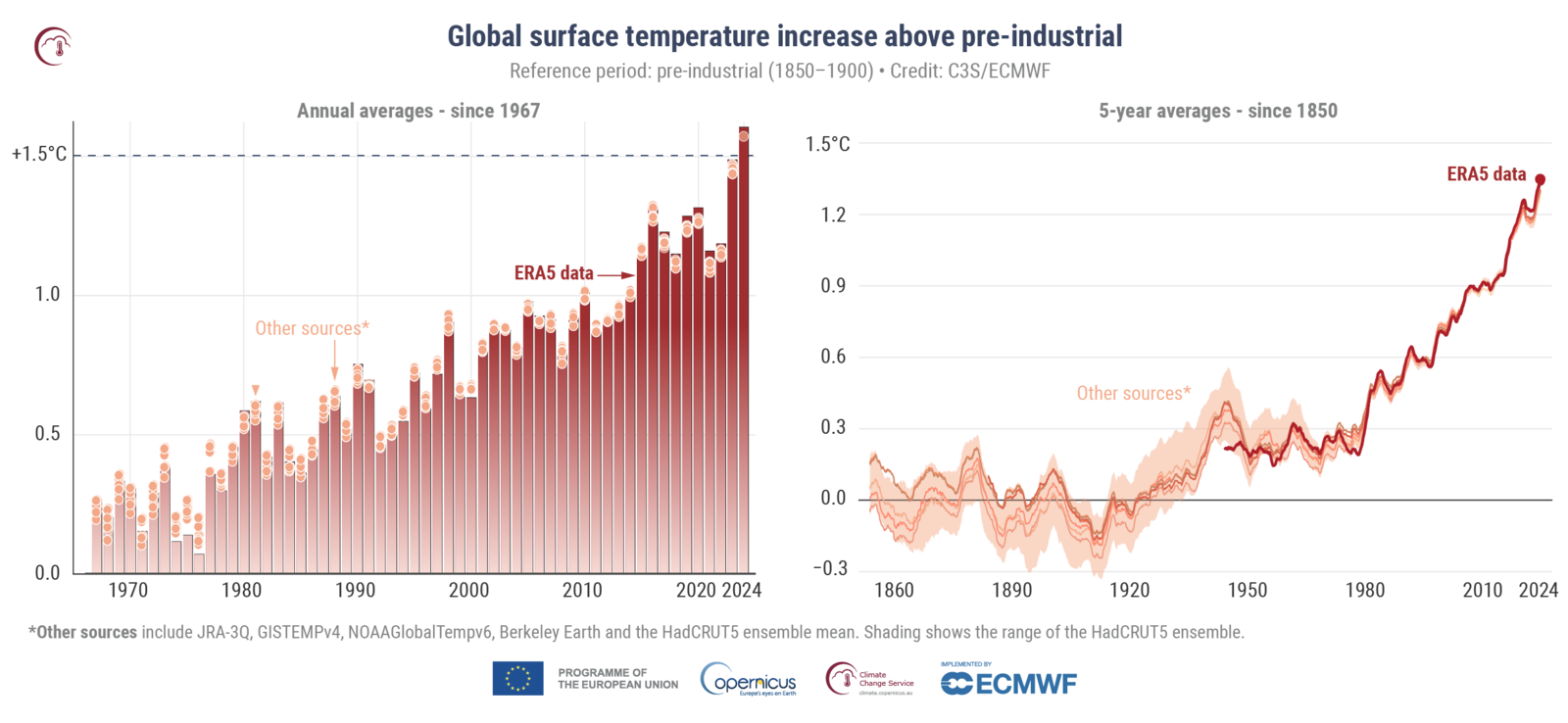
Source: Copernicus Climate Change Service / ECMWF, CC BY 4.0; locally resized. 2024 crossed 1.5°C as a calendar year; the Paris temperature goal is assessed over longer averages.
Open questions
What’s genuinely unsettled
- Can we ever predict a tipping date? Early-warning signals reliably detect lost resilience in clean experiments. Whether they can ever give trustworthy timing for a noisy, half-observed system like the AMOC is, right now, a real and open methodological fight.
- How coupled are the tipping elements? The nightmare scenario is a cascade — Greenland’s meltwater weakening the AMOC, a weakened AMOC drying the Amazon, and so on, one domino tipping the next. The links are plausible and partly modelled, but their strengths are not yet pinned down.
- Where exactly does simple part-by-part intuition stop? We can say feedback and nonlinearity mark the boundary — but turning “this system needs holistic treatment” into a sharp, quantitative test (rather than a judgment call) is unfinished business, tangled up with the strong-emergence question still open from Day 8.
- Can we engineer positive social tipping points on purpose? If reinforcing loops can flip a system into ruin, can they be deliberately seeded to flip it toward good — rapid decarbonization, say? The 2025 report bets yes. Whether that’s sound systems engineering or hopeful narrative is being tested in real time.
- Is the brain literally a control system? The Day 1 thread returns: predictive processing casts cognition as feedback minimizing surprise. Useful framing, or the literal architecture? (We’ll push on this at Days 119 and 123–126.)
Three sentences to carry forward
- Big idea
- To understand a body, a market, or a climate, watch the loops, not just the parts: feedback (balancing loops that stabilize, reinforcing loops that run away), stocks and flows, and the delays between them generate behaviour that no isolated component can show — and that human intuition reliably gets wrong.
- Best analogy
- The thermostat holding a goal against the cold (negative feedback) and the bathtub whose level keeps rising long after the faucet starts closing (stock lags flow) — scaled all the way up to a ball in a flattening valley that tips into a new basin and does not return along the same path.
- Live controversy
- That Earth systems can tip is established and early-warning signals detect lost resilience; but predicting a specific collapse date — the AMOC’s contested “~2057/2065” — outruns what the data can support, even as the underlying risk is real and may be underestimated.
Today's threads › emergence (feedback as the engine under “more is different”) · energy (open systems held from equilibrium by throughflow → Days 33, 83–85) · computation (system dynamics; the brain as controller) · information (stocks/flows; early-warning signals as evidence) — with a light touch of evolution (homeostasis, selected-for control).
Tomorrow → Day 10
Models, Maps & Idealization
Today we built models of systems — Forrester’s feedback worlds, Meadows’ bathtub, a ball in a valley — and trusted them to teach us. Tomorrow we turn the lens on the modelling itself. “The map is not the territory”; “all models are wrong, but some are useful.” When is a simplification illuminating and when is it a lie? We’ll meet the realism-vs-instrumentalism debate and the modern epistemology of simulations and digital twins — the question of how much to believe the very tools we just used.
Sources
Sources & further reading
- Maxwell, J. C. (1868). “On Governors.” Proceedings of the Royal Society of London 16: 270–283. doi:10.1098/rspl.1867.0055 — the mathematical birth of control theory. doi.org/10.1098/rspl.1867.0055
- Wiener, N. (1948). Cybernetics: Or Control and Communication in the Animal and the Machine. MIT Press. — coins “cybernetics”; names Maxwell 1868 the first feedback paper; thermostat & governor as exemplars.
- Forrester, J. W. (1961). Industrial Dynamics. MIT Press. Also Urban Dynamics (1969), World Dynamics (1971), and “Counterintuitive Behavior of Social Systems” (1971).
- Meadows, D. H. (2008). Thinking in Systems: A Primer (ed. D. Wright). Chelsea Green. — the field’s standard primer (posthumous).
- Meadows, D. H. (1999). Leverage Points: Places to Intervene in a System. The Sustainability Institute. (expanded from a 1997 essay in Whole Earth Review). donellameadows.org
- Meadows, D. H., Meadows, D. L., Randers, J. & Behrens, W. W. (1972). The Limits to Growth. Universe Books (Club of Rome; World3 model).
- Booth Sweeney, L. & Sterman, J. D. (2000). “Bathtub dynamics: initial results of a systems thinking inventory.” System Dynamics Review 16(4): 249–286. — stock-flow reasoning failures; in the harder sawtooth task, mean performance was under 50% and the area/accumulation criterion was 37%.
- Cronin, M. A., Gonzalez, C. & Sterman, J. D. (2009). “Why don’t well-educated adults understand accumulation?” Organizational Behavior and Human Decision Processes 108(1): 116–130. — the “correlation heuristic”; the CO₂-bathtub misconception.
- Sterman, J. D. (1989). “Modeling Managerial Behavior: Misperceptions of Feedback in a Dynamic Decision-Making Experiment.” Management Science 35(3): 321–339. doi:10.1287/mnsc.35.3.321 — the Beer Game & bullwhip effect. doi.org/10.1287/mnsc.35.3.321
- von Bertalanffy, L. (1968). General System Theory: Foundations, Development, Applications. George Braziller. — open systems, equifinality, the holist program.
- Scheffer, M. et al. (2009). “Early-warning signals for critical transitions.” Nature 461: 53–59 (3 Sep 2009). doi:10.1038/nature08227 — critical slowing down, rising variance & autocorrelation. doi.org/10.1038/nature08227
- Scheffer, M. (2009). Critical Transitions in Nature and Society. Princeton University Press. — bifurcations, alternative stable states, hysteresis.
- Armstrong McKay, D. I., Staal, A., Abrams, J. F., Winkelmann, R., Sakschewski, B., Loriani, S., Fetzer, I., Cornell, S. E., Rockström, J. & Lenton, T. M. (2022). “Exceeding 1.5°C global warming could trigger multiple climate tipping points.” Science 377(6611): eabn7950 (9 Sep 2022). doi:10.1126/science.abn7950 — the verified threshold table. doi.org/10.1126/science.abn7950
- Ben-Yami, M., Morr, A., Bathiany, S. & Boers, N. (2024). “Uncertainties too large to predict tipping times of major Earth system components from historical data.” Science Advances 10(31): eadl4841 (2 Aug 2024). doi:10.1126/sciadv.adl4841 — the methodological brake on date-prediction. doi.org/10.1126/sciadv.adl4841
- Ditlevsen, P. & Ditlevsen, S. (2023). “Warning of a forthcoming collapse of the Atlantic meridional overturning circulation.” Nature Communications 14: 4254 (25 Jul 2023). doi:10.1038/s41467-023-39810-w — central estimate 2057 (2025–2095); contested dating. doi.org/10.1038/s41467-023-39810-w
- Ditlevsen, P. & Ditlevsen, S. (2025). “Author Correction: Warning of a forthcoming collapse of the Atlantic meridional overturning circulation.” Nature Communications (21 Aug 2025). doi:10.1038/s41467-025-63201-y — correction moves the central estimate to about 2065 (2037–2109). doi.org/10.1038/s41467-025-63201-y
- van Westen, R. M., Kliphuis, M. & Dijkstra, H. A. (2024). “Physics-based early warning signal shows that AMOC is on tipping course.” Science Advances 10(6): eadk1189 (9 Feb 2024). doi:10.1126/sciadv.adk1189 — first AMOC tipping event in the Community Earth System Model under quasi-equilibrium freshwater forcing; deliberately no calendar date. doi.org/10.1126/sciadv.adk1189
- Flores, B. M. et al. (2024). “Critical transitions in the Amazon forest system.” Nature 626: 555–564 (14 Feb 2024). doi:10.1038/s41586-023-06970-0 — 10–47% of forest exposed to compounding disturbances by 2050. doi.org/10.1038/s41586-023-06970-0
- Boulton, C. A., Lenton, T. M. & Boers, N. (2022). “Pronounced loss of Amazon rainforest resilience since the early 2000s.” Nature Climate Change 12: 271–278. doi:10.1038/s41558-022-01287-8 — rising autocorrelation (an early-warning signal) across the Amazon.
- Lenton, T. M. et al. (eds.) (2023; 2nd ed. 2025). Global Tipping Points Report. University of Exeter. — the COP28 synthesis and its Oct 2025 update (warm-water coral reefs passing their tipping point; positive tipping points). global-tipping-points.org
- Copernicus Climate Change Service (2025). “Global Climate Highlights 2024” (10 Jan 2025; accessed 29 Jun 2026). — 2024 the first calendar year >1.5°C, at 1.60°C above 1850–1900; a single year does not equal a Paris-goal breach. climate.copernicus.eu
- NOAA Coral Reef Watch (2026). “Current Global Bleaching: Status Update & Data Submission” and NOAA NESDIS, “World’s Fourth Mass Coral Bleaching Event Likely Ended in 2025” (2 Jun 2026; accessed 29 Jun 2026). — 2023–2025 fourth global bleaching event, likely ended, with bleaching-level heat stress affecting about 84.4% of reef area. coralreefwatch.noaa.gov
- IPCC (2021). Climate Change 2021: The Physical Science Basis, WGI Chapter 9. — assessed confidence language for AMOC historical change, projected 21st-century weakening, and abrupt-collapse risk. ipcc.ch/report/ar6/wg1/chapter/chapter-9
- IPCC (2021). AR6 WGI, FAQ 5.1. — land and ocean sinks have taken up roughly half of anthropogenic CO₂ emissions over recent decades. ipcc.ch
Deep dive appendixDeeper WatersOptional extension.
The Day 9 lesson left us at the edge of a destabilizing planet, holding one hard-won distinction: that detecting a system’s loss of resilience is not the same as naming the year it breaks. That gap — between sensing fragility and forecasting failure — is the doorway to this appendix. Everything below lives in that gap. We’ve already met the skeleton of systems thinking: the thermostat and the governor, stocks and flows, the bathtub, the ball in its flattening valley. Now we go down past the textbook into the engine room — the strange people who built this science, the deep laws they uncovered, and the wildest idea any of them ever had: that a planet, with no brain and no plan, can hold its own temperature steady for billions of years using nothing but feedback. None of what follows is required to pass the day. All of it is the good stuff.
↩ Carried forward from Day 9
Assumed throughout (so we don’t repeat them): negative/balancing (B) loops stabilize, positive/reinforcing (R) loops run away; stocks accumulate what flows deliver; delay turns correction into oscillation; a fold bifurcation with hysteresis is the shape of a tipping point; and critical slowing down is its warning sign. We’ll lean on every one of these and add new floors beneath them.
Room Ithe engine room
How a war, a ferry, and a dinner party invented cybernetics
Norbert Wiener didn’t set out to found a science of control. He set out to shoot down aeroplanes. In 1940, with Britain under bombardment, the American mathematician was handed a brutally practical problem: anti-aircraft gunners couldn’t hit fast planes because a shell takes time to climb, and by the time it arrives the plane has moved. To hit the target you must fire not where it is but where it will be — you must predict. Wiener built a statistical predictor that treated the pilot’s evasive jinking as a noisy signal to be extrapolated, and in wrestling with it he noticed something that would consume the rest of his life: the gun, the radar, and the dodging pilot formed a single loop of sensing, predicting, and correcting, and the same loop described an animal stalking prey, a hand reaching for a glass, a brain. Prediction and feedback were two faces of one thing. (The historian Peter Galison has argued that this wartime fusion of human and machine into one feedback circuit quietly shaped the entire worldview of cybernetics.)
The hardware side of the story is even better, and it had happened a decade earlier on a commuter ferry. In August 1927, a young Bell Labs engineer named Harold Black was crossing the Hudson, stuck on a problem that was strangling the telephone industry: amplifiers for long-distance calls distorted the signal a little, and across thousands of miles of repeaters those little distortions compounded into mush. Black’s flash of insight, which he scribbled on the only paper he had — a copy of The New York Times — was almost perverse: deliberately feed a portion of the amplifier’s output back to its input with the sign flipped, so the amplifier continuously corrects its own errors. He was throwing away gain to buy accuracy. The negative-feedback amplifier made coast-to-coast telephony possible and, not incidentally, vindicated Maxwell’s old warning from Day 9: feedback can stabilize, but wire it wrong and it screams. Within a few years Harry Nyquist and Hendrik Bode (both at Bell Labs) had worked out the mathematics of exactly when a feedback loop stays stable versus bursts into oscillation — the formal engineering of the line between control and catastrophe.
Then came the dinner parties. Between 1946 and 1953, a rotating cast of the century’s most restless minds gathered for a series of meetings funded by the Josiah Macy Jr. Foundation — the Macy Conferences — to ask whether feedback, information, and control might be a single language spanning machines, brains, and societies. The guest list is almost comic in its density: Wiener, the polymath John von Neumann, the neurophysiologist Warren McCulloch, the anthropologists Margaret Mead and Gregory Bateson, and the British psychiatrist W. Ross Ashby. Out of that cauldron came the conviction that organization itself — in a cell, a thermostat, a market, a mind — could be studied as one subject. Later thinkers, led by Heinz von Foerster, added a vertiginous twist they called second-order cybernetics: the observer studying a system is part of a feedback loop with it, so there is no view from nowhere. A scientist watching a society changes it by watching; a “cybernetics of cybernetics.” We’ll meet that snake-eating-its-tail again when this course reaches the science of mind.
Ashby’s law: only variety can absorb variety
Of all the deep laws to come out of that period, the one most worth carrying is Ashby’s, and it sounds almost too simple to be profound. A regulator — a thermostat, an immune system, a government, a goalkeeper — faces a world that can throw a certain number of distinct disturbances at it. Call that number the world’s variety. Ashby proved that to hold an outcome steady, the regulator must command at least as much variety as the disturbances it faces. Only variety can absorb variety. A goalkeeper with one fixed dive cannot stop shots aimed everywhere; an immune system with ten antibodies cannot defeat a thousand pathogens; a policy with a single lever cannot govern a society that can go wrong in a hundred ways. This is the Law of Requisite Variety, and it is the iron reason that simple controllers fail against complex worlds — and why every successful regulator is, secretly, at least as complicated as its problem.
Keep this law in your pocket. It will return, transformed, as a reason large language models need staggering scale to handle the variety of language, as the logic behind biological diversity buffering ecosystems, and as the quiet mathematics under “you can’t manage what you can’t match.”
Room IIa republic of loops
Your body is ten thousand thermostats
Long before Wiener, the most sophisticated feedback machine on Earth was sitting inside every reader of this page. In 1865 the French physiologist Claude Bernard noticed something that should have caused more fuss than it did: the fluid bathing our cells — the milieu intérieur, the “internal environment” — stays eerily constant even as the outside world swings wildly. Your blood is the same warm, salty, sugar-balanced broth whether you’re in a blizzard or a sauna. Bernard’s line became one of the most quoted in biology: the constancy of the internal environment is the condition for a free and independent life. Seventy years later the American physiologist Walter Cannon gave the phenomenon its name — homeostasis, “steady-state” — and spelled out that it is achieved by exactly the negative-feedback loops we’ve been tracking, just rendered in flesh and hormones instead of brass.
The examples are everywhere once you see them. Your blood sugar is a stock regulated by two opposing flows: when it rises after a meal, the pancreas releases insulin to push glucose into cells; when it falls, glucagon releases it from storage — a thermostat with two hormones for a sensor and a switch. Your core temperature is held near 37°C by sweating, shivering, and the rerouting of blood. Your blood pressure is policed second-by-second by the baroreflex: stretch receptors in your arteries sense pressure and reflexively adjust your heart rate to counter it. Stand up too fast and feel the half-second lag before the loop catches up — that brief dizziness is delay-induced overshoot, the baroreflex doing its Beer-Game stumble. You are not one thermostat; you are a teeming republic of them, mostly arguing in your favour.
The useful exception: when the body wants a runaway
Biology mostly wants stability, so it mostly uses negative feedback. But every so often it needs an event — something fast, decisive, irreversible — and for that it reaches for positive feedback, carefully caged. Childbirth is the classic: the baby’s head stretches the cervix, which triggers oxytocin, which strengthens contractions, which stretch the cervix further — an explosive R loop that amplifies until delivery interrupts the loop. Blood clotting cascades the same way; so does the firing of a neuron, where a trickle of charge flings open the gates for a flood. Positive feedback isn’t the body’s enemy. It’s the body’s detonator — used sparingly, with a hand always on the off-switch.
And here the appendix loops back to the very first day of this course. The old picture of homeostasis is purely reactive: wait for a deviation, then correct it. But physiologists increasingly favour a richer idea called allostasis — “stability through change” — in which the body doesn’t wait for the error at all. It predicts demand and adjusts in advance: your cortisol rises before you wake, your heart rate climbs in anticipation of exertion, not in response to it. Regulation becomes feedforward, not just feedback — anticipatory control. If that rings a bell, it should: it is the bodily cousin of the predictive brain from Day 1, Friston’s machine that minimizes surprise by modelling the world before it arrives. Cybernetics’ deepest modern turn is the realization that the best controllers don’t merely react to the world — they see it coming.
Room IIIwhen cybernetics tried to run the world
A socialist control room and a doomsday model
If feedback governs bodies and machines, the temptation was irresistible: why not govern an economy with it? In 1971, the British management theorist Stafford Beer — a cigar-smoking, yoga-practising guru of “management cybernetics” — was invited by Salvador Allende’s newly elected socialist government to do exactly that, for the entire nation of Chile. The result, Project Cybersyn (Synco, in Spanish), is one of the strangest and most haunting episodes in the history of technology: an attempt to run a national economy as a single self-regulating organism, in real time, with the computing power of one mainframe and a few hundred telex machines.
The system had a daily heartbeat. Factories wired their production figures over a repurposed telex network (“Cybernet”) to a central computer in Santiago, which fed back warnings when a number drifted out of its expected range — a national nervous system signalling pain. At its heart sat the Opsroom: a hexagonal chamber of seven white fibreglass swivel chairs, each with big buttons on the armrest, facing wall-mounted screens displaying the state of the economy. It looked like the bridge of a starship and was meant to be a place where managers could see the country’s feedback loops and steer them. The system’s finest hour came in October 1972, when a strike by truck owners threatened to choke the country’s supply lines; the government used the Cybernet telex network to coordinate a small loyal fleet — often reported as about 200 trucks — while tens of thousands of truck owners were on strike, and kept the nation fed. A little over a year later, the project died in a single afternoon — the military coup of 11 September 1973 swept away Allende, and Cybersyn with him. It remains the most ambitious attempt ever made to govern a society by explicit feedback, equal parts inspiration and warning: a real system, genuinely operational, though whether it could ever have worked at scale runs straight into Ashby’s Law. Can one control room ever hold variety enough to match a whole economy?
The model that refused to die
The other great attempt to model a whole system was quieter but louder in its afterlife. Day 9 named The Limits to Growth (1972) as part of Donella Meadows’ systems work; here is what its World3 model actually did, and why it still starts arguments fifty years on. A team at MIT built a system-dynamics model with five tightly looped global stocks — population, food production, industrial output, pollution, and nonrenewable resources — and let it run to the year 2100 under different assumptions. The headline “standard run,” with business roughly as usual, produced a disturbing shape: growth continuing for decades, then overshoot and a sharp 21st-century decline in population and output as resource depletion and pollution caught up. The reaction was ferocious. Economists savaged it; the model was crude, its resource estimates pessimistic, its omission of price-driven adaptation and human ingenuity glaring. For a generation, “Limits to Growth” was a byword for doom-mongering that history had supposedly refuted.
And then the data started coming in. In 2008 and again in 2014, the Australian physicist Graham Turner (CSIRO) compared three to four decades of real-world statistics against the 1972 scenarios and found, uncomfortably, that the world had been tracking the “standard run” with eerie fidelity. In 2021, the analyst Gaya Herrington updated the comparison with fresh data and reached a similar verdict: empirical trends sat closest to the model’s business-as-usual and “comprehensive technology” runs, both of which imply growth stalling around the 2040s. The hype-filtered reading matters here, because it cuts both ways. This is not a validated prophecy — World3 is a coarse model, the agreement is partly coincidental, and “the standard run fits so far” says little about the exact timing or inevitability of any decline. But the lazy dismissal — that it was simply wrong — is also false: the data-tracking studies are real. The truth is the more unsettling middle: a 50-year-old systems model of overshoot has not yet been embarrassed by reality. Which is the perfect place to hand you to tomorrow’s question — how much should we ever believe a model? — but we’re getting ahead of ourselves.
Room IVthe crown jewel
The twelve places to push
The single most practical thing Donella Meadows ever wrote was a ranked list. We sketched it in Day 9 — parameters are weak, paradigms are strong — but the full ladder rewards a proper look, because it inverts almost everything our instincts tell us about how to change a system. We reach reflexively for the bottom rungs (adjust a number, set a target) precisely because they’re easy to grasp and easy to push. The trouble is that they’re also the weakest. The real power sits higher up, where the leverage is enormous and the handhold is hard. The table below groups the twelve rungs by the kind of change they make.
Interactive · Meadows' leverage points
Places to Intervene in a System
Ranked from 12 (weakest) to 1 (strongest), after Donella Meadows. Tap any rung to see why higher leverage is stronger and harder to reach.
Static alternate · Meadows' leverage points
From weak to strong, interventions move from parameters, buffers, and plumbing toward information flows, rules, self-organization, goals, and paradigms.
| Level | Examples | Why it matters |
|---|---|---|
| 12-10 | Parameters, buffers, stock-flow structure | Most visible, often only tuning. |
| 9-6 | Delays, balancing loops, reinforcing loops, information flows | Changes how feedback reaches actors. |
| 5-1 | Rules, self-organization, goals, paradigms, transcending paradigms | Changes what the system optimizes for and can imagine. |
Meadows’ leverage points, grouped
| Level | Examples | Why it matters |
|---|---|---|
| 12-10 | Parameters, buffers, stock-flow structure | Most visible, often only tuning. |
| 9-6 | Delays, balancing loops, reinforcing loops, information flows | Changes how feedback reaches actors. |
| 5-1 | Rules, self-organization, goals, paradigms, transcending paradigms | Changes what the system optimizes for and can imagine. |
Notice the shape of the lesson. Tax tweaks and targets — the entire substance of most political argument — live at the bottom. The transformative rungs are about feedback (rungs 8–6: strengthen a balancing loop, slow a reinforcing one, add a missing information channel), then about structure and rules (5–4), and finally about purpose and worldview (3–1). Meadows’ own favourite illustration of a high-leverage information fix is almost too neat: a Dutch housing development where, by accident of design, some homes had their electricity meters in a visible front hallway and others tucked in the basement. The visible-meter households used markedly less power — perhaps a third less — for no reason but that a feedback loop which had been hidden was suddenly in plain sight. No tax, no rule, no technology. Just information completing a loop. That is leverage.
Room Vthe bestiary
The same traps, over and over
Spend long enough drawing causal loop diagrams and you notice something liberating: the same handful of loop-shapes generate a startling fraction of the world’s chronic problems. Forrester, Meadows, and Peter Senge catalogued these recurring structures as system archetypes — the stock characters of dysfunction. Learn to recognize a few and you can often diagnose a stuck situation on sight, and (more usefully) predict where the obvious fix will backfire. Here are the most useful, each as a one-breath loop story.
Tragedy of the Commons · R
each user gains → all overuse → shared resource collapses → everyone loses
When a resource is shared but the gains are private, each rational actor takes a little more, and the reinforcing pull of individual benefit grazes the common pasture bare. The fix lives high on the ladder: change the rules or the information so the cost of overuse is felt by the user.
Shifting the Burden · B
problem → quick symptomatic fix → relief → real capacity atrophies → problem worsens
The “addiction” archetype. A symptomatic fix relieves the pressure that might have driven a fundamental solution — so the underlying capacity withers and dependence deepens. The relief is real; that’s the trap.
Fixes That Fail · B
problem → fix → quick relief → delayed side-effect → problem returns, bigger
A solution works beautifully in the short run and quietly sows a long-run consequence that brings the problem back worse. Borrowing to cover a shortfall; spraying a pest that wipes out its predators. The delay is what hides the cost.
Success to the Successful · R
A wins early → A gets more resources → A wins more → B starves
When winners are rewarded with the means to win again, small initial differences amplify into runaway dominance — the rich-get-richer loop behind market monopolies, academic prestige, and unequal schools. Pure positive feedback, scaled.
Limits to Growth · R+B
growth engine (R) speeds up → hits a hidden constraint (B) → growth stalls or crashes
Every reinforcing success eventually meets a balancing limit it didn’t see coming — a resource, a market size, a carrying capacity. The World3 model is this archetype written at planetary scale. Growth never simply continues; it negotiates with a ceiling.
Escalation · R
A acts → B counter-acts → A escalates → B escalates → both worse off
Two balancing loops, each trying to restore its own sense of safety, couple into a single reinforcing spiral: arms races, price wars, social-media outrage cycles. No one is irrational; the structure does the damage.
The deep point isn’t the catalogue itself — it’s that structure drives behaviour. In every archetype, well-meaning people making locally sensible choices produce a collectively terrible outcome, not because anyone is foolish but because the loops they’re embedded in steer them there. Change the people and the trap persists; change the structure and the behaviour changes itself. That is the whole creed of systems thinking in a sentence.
Room VIthe deep theory of collapse
How resilience dies — three different ways
Day 9 gave you one image of a tipping point: a valley flattening until the ball rolls out. That’s true, but it’s only one of three distinct ways a system can tip, and conflating them causes real confusion in the climate debate. First, though, we need a sharper idea of what’s actually being lost when a system “tips” — and for that we go back to a foundational 1973 paper by the ecologist C. S. “Buzz” Holling, who pried apart two things everyone had been calling “stability.”
Engineering resilience is how fast a system snaps back after a knock — the steepness of the valley walls. Ecological resilience is something else entirely: how big a shock the system can absorb before it flips into a different basin altogether — the width of the valley, the size of the disturbance it can swallow. These can pull in opposite directions, which is the part that matters. A system can snap back from small knocks beautifully (high engineering resilience) while sitting in a narrow basin that a single large shock would tip forever (low ecological resilience). Efficiency often buys the first by quietly spending the second. Day 9 measured a valley’s depth; Holling teaches you to also watch its width.
Now, the three roads to collapse. Dynamical-systems theorists (notably Peter Ashwin and colleagues, in a clarifying 2012 paper) sorted tipping into three mechanisms, and the distinction is genuinely illuminating:
Bifurcation tipping (B-tipping) is the one we already know: push a driver past a threshold and the stable state vanishes. Noise-induced tipping (N-tipping) is when the driver is still safely below threshold, but a large enough random fluctuation — a freak heatwave, a once-a-century storm — kicks the system over the ridge anyway. And then the genuinely counterintuitive one: rate-induced tipping (R-tipping), where what matters is not how far the driver moves but how fast. A system that could comfortably track a slow change can be tipped by the same change applied too quickly — the valley floor tilts faster than the ball can roll to keep up, and it spills out even though a leisurely version of the identical shift would have been survived. This matters for climate precisely because it means a threshold in temperature isn’t the only danger; a threshold in the rate of warming may matter just as much. Ecosystems and ice don’t only care where we end up. They care how fast we get there.
Dominoes, and the wheel of renewal
Two final ideas round out the deep theory. The first is the one that keeps climate scientists up at night: tipping cascades. The Earth’s tipping elements aren’t independent — they’re wired together, so one tipping can shove another toward its own edge. Modelling work from the Potsdam Institute (Wunderling, Donges and colleagues, 2021) found that interactions between elements tend, on balance, to lower the safe thresholds and raise the odds of domino effects, with the great ice sheets often acting as the first domino and a weakening Atlantic conveyor as a transmitter. The magnitudes are still genuinely uncertain, but the direction of the finding is the worrying one: coupled systems are more fragile than the sum of their parts — emergence, from Day 8, wearing its darkest coat.
The second idea is strangely consoling. The ecologist Holling, late in his career, proposed that complex systems don’t just sit in basins or tip out of them — they move through a recurring adaptive cycle: a phase of rapid growth, then a long phase of rigid accumulation and efficiency, then a sudden release or collapse (he marked it Ω, “creative destruction”), then a fertile reorganization from which new growth springs. Collapse, in this view, is not only catastrophe; it is also the system clearing the board for renewal, and these cycles nest inside one another across scales — a framework he called panarchy. It’s a reminder that “tipping” isn’t always the end of a story. Sometimes it’s the hinge between one story and the next.
Room VIIhomeostasis without foresight
Daisyworld: homeostasis with no one home
We end where systems thinking becomes almost philosophical. In the 1970s, the chemist James Lovelock proposed the Gaia hypothesis: that life and the Earth’s surface form a single self-regulating system, holding temperature, atmospheric chemistry, and ocean salinity within the narrow bands life needs — much as a body holds its internal milieu. The idea was beautiful and immediately attacked, on one devastating objection: it seemed to require foresight. How could a planet’s microbes “want” to regulate the climate? Evolution has no goals; natural selection acts on individual organisms, not on planets. Regulation for the good of the whole looked like teleology smuggled into biology — and biologists, rightly, don’t allow that.
Lovelock’s answer, built with Andrew Watson in 1983, is one of the most elegant toy models in all of science, and it answers the objection in the clean world of the model. It is called Daisyworld, and it has no biologist’s hand-waving in it at all — just feedback. Imagine a grey planet orbiting a slowly brightening star, seeded with two kinds of daisy: black daisies, which absorb sunlight and warm their surroundings, and white daisies, which reflect it and stay cool. Each daisy simply grows fastest near a comfortable temperature and dies off when it’s too hot or too cold. There is no foresight, no cooperation, no planetary “purpose” — only individual daisies selfishly growing where they grow best. Watch what their blind feedback does to the temperature of the entire world.
Interactive · the parable of Daisyworld
A World That Holds Its Own Temperature
Drag solar luminosity. The dashed line is a lifeless rock; the blue line is planetary temperature after black-white daisy feedback. Too dim or too bright and daisies cannot hold; in the middle, black daisies warm and white daisies cool, flattening the temperature into a regulating plateau.
Static alternate · Daisyworld
Life flattens the temperature curve inside a middle luminosity range; too dim or too bright and daisies cannot persist, so regulation fails.
| Solar luminosity | Daisy mix | Temperature result |
|---|---|---|
| Too dim | Daisies cannot persist | Regulation fails; temperature follows dead rock |
| Dim | More black daisies | Absorbs heat and warms the world |
| Moderate | Black and white daisies regulate together | Temperature stays on a habitable plateau |
| Too bright | Daisies die out | Regulation fails and temperature follows dead rock |
Daisyworld, as regulation without foresight
| Solar luminosity | Daisy mix | Temperature result |
|---|---|---|
| Dim | More black daisies | Absorbs heat and warms the world |
| Moderate | Black and white daisies regulate together | Temperature stays on a habitable plateau |
| Too bright | Daisies die out | Regulation fails and temperature follows dead rock |
That flat plateau is the whole point — and there is not a shred of foresight anywhere in the model. When the star is dim, only black daisies can get a toehold; they spread, darken the planet, and warm it — a reinforcing loop that bootstraps the world up to a livable temperature. As the star brightens and the planet would otherwise overheat, white daisies start to outcompete the black ones (they stay cooler, so they grow better in the heat), and as white coverage spreads it reflects more sunlight and cools the planet back down. The mix of daisies shifts automatically to counteract the changing sun. Robust planetary self-regulation emerges from nothing but selfish local growth plus feedback — exactly Day 8’s “more is different,” now keeping a world alive. Daisyworld shows, in a toy model, how feedback can regulate a planet-like system without foresight. It doesn’t prove Gaia is true; the strong claim that Earth’s biosphere actively regulates the planet for life’s benefit remains contested. But it demolishes the charge that such regulation would require foresight — and that is a profound result. Purpose-like behaviour can fall out of pure mechanism. The planet keeps its temperature for the same reason your body keeps its own: not because anything wants it to, but because the loops are wired that way.
Open questions
What this appendix opened
- Is requisite variety a hard limit on governance? If Ashby is right, no control room — Cybersyn or otherwise — can ever match the variety of a whole economy. Does that doom central planning, or just demand that complexity be met with distributed control rather than one heroic dashboard?
- How much is regulation actually predictive? Allostasis says the body sees demand coming. The brain (Day 1) may do the same. How far down does anticipatory, feedforward control go — to single cells? To ecosystems?
- Does rate-induced tipping change the climate target? If systems can tip from the speed of change and not just its size, then “stay under 1.5°C” may be necessary but not sufficient — the pace of the approach could matter independently.
- Is collapse sometimes renewal? Panarchy reframes the Ω-phase as creative destruction. When is a tipping point a catastrophe to prevent, and when is it the hinge a rigid system needs to reorganize?
- If Daisyworld self-regulates without foresight, what else does? Markets, immune systems, language, perhaps minds — how much apparent “purpose” in nature is really just feedback we haven’t yet diagrammed?
The appendix in three sentences
The history: feedback control grew from a wartime gun and a ferry-boat sketch into cybernetics, whose deepest law — Ashby’s requisite variety — says a regulator must be as various as the trouble it faces, a law you can feel in your own body’s ten thousand homeostatic loops and in Chile’s doomed attempt to run an economy from a single futuristic control room.
The deep theory: resilience comes in two flavours (fast-return and big-shock-tolerant) that can trade off invisibly, and a system can tip three different ways — by crossing a threshold, by a random kick, or, most sneakily, by being pushed too fast — with coupled tipping elements making the whole more fragile than its parts.
The capstone: Daisyworld shows, in a toy model, how a planet-like system can hold its temperature steady for ages with no foresight whatsoever, purely because selfish local growth plus feedback adds up to global self-regulation — homeostasis with no one home, and a clean demonstration that purpose-like order can emerge from blind mechanism.
→ back to the descent
Everything here was a deepening of Day 9. The descent itself continues at Day 10 — Models, Maps & Idealization: we just trusted World3, the leverage ladder, and a planet made of daisies to teach us real things — so tomorrow we ask the unavoidable question lurking under all of it. The map is not the territory; all models are wrong, but some are useful. When is a simplification a lamp, and when is it a lie?
Sources & further reading
- Wiener, N. (1948). Cybernetics. MIT Press. See also Galison, P. (1994). “The Ontology of the Enemy: Norbert Wiener and the Cybernetic Vision.” Critical Inquiry 21(1): 228–266. — the anti-aircraft predictor as the seed of feedback thinking.
- Black, H. S. (1934). “Stabilized Feedback Amplifiers.” Bell System Technical Journal 13(1): 1–18. (invention conceived Aug 1927; U.S. Patent 2,102,671, 1937). The ferry-sketch origin of negative-feedback electronics.
- Nyquist, H. (1932). “Regeneration Theory.” Bell System Technical Journal; Bode, H. (1945). Network Analysis and Feedback Amplifier Design. — the stability mathematics of feedback.
- Macy Conferences on Cybernetics (1946–1953). See Heims, S. J. (1991). The Cybernetics Group. MIT Press; Pias, C. (ed.) (2016). Cybernetics: The Macy Conferences 1946–1953. — Wiener, von Neumann, McCulloch, Mead, Bateson, Ashby.
- von Foerster, H. (1974). Cybernetics of Cybernetics. Univ. of Illinois. — second-order cybernetics; the observer inside the loop.
- Ashby, W. R. (1956). An Introduction to Cybernetics. Chapman & Hall. — the Law of Requisite Variety; the homeostat. full text
- Bernard, C. (1865). Introduction à l’étude de la médecine expérimentale. — the milieu intérieur.
- Cannon, W. B. (1932). The Wisdom of the Body. Norton. — coins “homeostasis” (term introduced 1926).
- Sterling, P. (2012). “Allostasis: A model of predictive regulation.” Physiology & Behavior 106(1): 5–15. (concept: Sterling & Eyer 1988). — stability through anticipatory change; the link to predictive regulation.
- Medina, E. (2011). Cybernetic Revolutionaries: Technology and Politics in Allende’s Chile. MIT Press; Beer, S. (1972). Brain of the Firm. — Project Cybersyn (1971–73) and the Viable System Model.
- Meadows, D. H., Meadows, D. L., Randers, J. & Behrens, W. W. (1972). The Limits to Growth. Universe Books. — the World3 model.
- Turner, G. M. (2008). “A comparison of The Limits to Growth with 30 years of reality.” Global Environmental Change 18(3): 397–411; Turner (2014), MSSI Research Paper No. 4, Univ. of Melbourne. — data tracks the “standard run.”
- Herrington, G. (2021). “Update to limits to growth: Comparing the World3 model with empirical data.” Journal of Industrial Ecology 25(3): 614–626. doi:10.1111/jiec.13084 — empirical data closest to BAU2 / comprehensive-technology runs. doi.org/10.1111/jiec.13084
- Meadows, D. H. (1999). Leverage Points: Places to Intervene in a System. The Sustainability Institute. — the ranked twelve; the Dutch electricity-meter example (also in Thinking in Systems, 2008). donellameadows.org
- Senge, P. (1990). The Fifth Discipline. Doubleday. — the system archetypes (with Forrester & Meadows lineage).
- Holling, C. S. (1973). “Resilience and Stability of Ecological Systems.” Annual Review of Ecology and Systematics 4: 1–23. — engineering vs ecological resilience. Gunderson, L. & Holling, C. S. (2002). Panarchy. Island Press. — the adaptive cycle.
- Ashwin, P., Wieczorek, S., Vitolo, R. & Cox, P. (2012). “Tipping points in open systems: bifurcation, noise-induced and rate-dependent examples in the climate system.” Phil. Trans. R. Soc. A 370: 1166–1184. doi:10.1098/rsta.2011.0306 — the B / N / R taxonomy. doi.org/10.1098/rsta.2011.0306
- Wunderling, N., Donges, J. F., Kurths, J. & Winkelmann, R. (2021). “Interacting tipping elements increase risk of climate tipping cascades.” Earth System Dynamics 12: 601–619. doi:10.5194/esd-12-601-2021 — coupling lowers thresholds; ice sheets as initiators. doi.org/10.5194/esd-12-601-2021
- Watson, A. J. & Lovelock, J. E. (1983). “Biological homeostasis of the global environment: the parable of Daisyworld.” Tellus B 35(4): 284–289. doi:10.1111/j.1600-0889.1983.tb00031.x — self-regulation without foresight. doi.org/10.1111/j.1600-0889.1983.tb00031.x
Deep dive appendixCatching the CliffOptional extension.
For sixty years, the science of tipping points could do one concrete thing: detect a loss of resilience. As Day 9 showed, a system approaching a cliff slows down — it varies more and recovers more slowly, producing statistical early-warning signals such as rising variance and autocorrelation. But those signals do not tell you what transition is coming, when it will occur, or what follows it. Since about 2020, researchers have used machine learning, satellites, and new mathematical methods to address those limits. This appendix surveys five active programs from the last six years. Each remains unfinished, so every claim is calibrated as frontier evidence rather than a settled conclusion.
↩ What you already have (and we won't repeat)
From Day 9: fold bifurcations, hysteresis, critical slowing down, the generic early-warning signals (Scheffer et al. 2009), Ben-Yami et al. 2024 on why dates are hard, and the climate specifics (AMOC, Amazon, coral, the 2022 threshold table). From Appendix I: Holling resilience, the B/N/R tipping taxonomy, tipping cascades, Daisyworld. Here we build on all of it — and only cover work published 2020 or later.
Dispatch 1teaching machines to hear the tremor
Classifying routes to a tipping point
Start with the deepest problem in the classic warning signals: they are generic to a fault. Rising variance and autocorrelation appear before almost any kind of tipping, which is their strength — they work everywhere — but also their weakness: they cannot tell you which kind of tipping is coming, and so they cannot tell you what the new world will be like. Will the system jump abruptly to a far-off state? Start oscillating wildly? Slide gently into a new regime? The generic signal shrugs at all three.
In 2021, a team led by Thomas Bury, with Chris Bauch, Madhur Anand, Marten Scheffer, and Tim Lenton, published a result in PNAS. Their method uses a mathematical property from Day 9: near a tipping point, many systems can be approximated by one of a small number of templates called normal forms — including the fold, Hopf, and transcritical bifurcations. Bury’s team trained a convolutional-recurrent neural network on hundreds of thousands of simulated time series drawn from these templates, teaching it to distinguish several routes to transition.
Their network detected tipping points in systems it was never trained on — including real climate and ecological data and a thermoacoustic experiment — more sensitively and with fewer false alarms than the classic indicators. It also classified the type of bifurcation, distinguishing a sudden jump, an oscillation, or a gentler shift. A 2025 follow-up (Zhuge, Li & Chen, Royal Society Open Science) extended the approach to irregularly sampled time series, a common feature of real-world monitoring and a limitation of the original method.
Interactive · the same tremor, three different cliffs
What a Classifier Hears That You Can't
Pick a route to collapse. Variance and autocorrelation can rise in all three, so alarm strength is not enough; the classifier reads the approach shape and separates a jump, an oscillation, and a stability exchange.
Static alternate · Tipping classifier
Variance and autocorrelation rise in many routes to tipping; the classifier reads the shape of approach to separate fold, Hopf, and transcritical bifurcations.
| Route | Shape | Landing |
|---|---|---|
| Fold | Slow approach, then sudden jump | System lands in a distant state |
| Hopf | Oscillation grows | The future is a cycle, not a new level |
| Transcritical | Stabilities exchange | One state slides out as another takes over |
Tipping classifiers, as three routes
| Route | Shape | Landing |
|---|---|---|
| Fold | Slow approach, then sudden jump | System lands in a distant state |
| Hopf | Oscillation grows | The future is a cycle, not a new level |
| Transcritical | Stabilities exchange | One state slides out as another takes over |
The calibrated label is promising. Most evidence remains in silico, supplemented by a handful of empirical cases. Whether a normal-form-trained network can identify tipping points reliably in noisy, high-dimensional Earth-system data, with useful lead time, remains to be demonstrated at scale.
Dispatch 2rehearsing the collapse in a machine
The digital twin that visits the far side
Detecting that a transition is near is one task. A 2020–2021 program asks whether a machine trained only on a system’s normal regime can predict its critical transition and post-tipping dynamics. The tool is reservoir computing, a recurrent-network method that can learn chaotic dynamics from raw data without an explicit model of the underlying physics.
In a 2021 Physical Review Research paper, Ling-Wei Kong, Ying-Cheng Lai, and colleagues supplied a reservoir computer with both the system’s behavior and the slowly drifting parameter pushing it toward the transition — a “parameter input channel.” Trained only on data from the safe regime, the machine then extrapolated to unseen parameter values, predicting where the critical transition lay and statistical properties of the transient state before final collapse. Follow-up work (Dhruvit Patel and Edward Ott, Chaos, 2023) used machine learning to “anticipate tipping points and extrapolate to post-tipping dynamics” of changing systems. Kong’s group describes such trained reservoirs as digital twins of nonlinear systems: data-driven stand-ins that can be tested beyond the observed regime in software.
The aim is a learned surrogate that can be tested beyond the observed regime without perturbing the real system.
The method works on benchmark chaotic systems, but those systems are relatively low-dimensional, well sampled, and cleanly measured. Climate data are high-dimensional, sparse, and non-stationary in ways that can defeat the assumption that future dynamics resemble the training regime. The same community has published “Catch-22” analyses of reservoir computing’s limits. Results on toy systems are promising; a trustworthy digital twin of the AMOC does not yet exist, and real-Earth applications remain unproven.
Dispatch 3the cliff that isn’t there
How a pattern lets a system dodge the edge
Another result questions whether a spatially extended ecosystem must collapse all at once after crossing a threshold. In 2021, Max Rietkerk and colleagues argued in Science that spatial structure can change this outcome.
Instead of collapsing all at once, a spatially extended system under stress can reorganize into a pattern — the spots, stripes, and labyrinths visible in drylands around the world. These are Turing patterns, the self-organized structures Alan Turing predicted in 1952. Ecologists have often read such patterns as warning signs of imminent collapse; Rietkerk’s analysis shows that they can instead indicate resilience. By breaking into patches, a system can persist under more stress than a uniform version. It can replace abrupt collapse with an often reversible retreat into pattern: a ramp rather than a cliff.
Interactive · evade or collapse
The Escape Hatch of Spatial Patterns
Raise environmental stress. With self-organization off, the system collapses at its tipping point; turn it on and patterns let it persist far longer.
Static alternate · Pattern evasion
A uniform system collapses at its threshold; with spatial self-organization, it can break into patterns and trade uniform cover for longer persistence.
| Mode | As stress rises | Lesson |
|---|---|---|
| Uniform | Collapses once the threshold is crossed | No spatial structure remains to retreat into |
| Patterns allowed | Forms patches and persists under higher stress | Self-organization can evade a tipping point for a while |
| Stress too high | Patterns thin out and fail | Evasion is not immunity; it buys time |
Pattern evasion, as two system designs
| Mode | As stress rises | Lesson |
|---|---|---|
| Uniform | Collapses once the threshold is crossed | No spatial structure remains to retreat into |
| Patterns allowed | Forms patches and persists under higher stress | Self-organization can evade a tipping point for a while |
| Stress too high | Patterns thin out and fail | Evasion is not immunity; it buys time |
If the framework generalizes, some ecosystems and Earth-system components classified as tipping-prone may be more resilient than models without spatial dynamics imply. The argument combines mathematics with field observations, but it is a review and theoretical framework, not a universal law. Its applicability to ice sheets, the Amazon, and the whole Earth system remains open. It also complicates warning signals, because a pattern can indicate either approaching collapse or persistence. The idea is promising; its general scope is unknown.
Dispatch 4a stethoscope for the planet
Reading the Earth’s resilience from orbit
Classic warning signals were developed on comparatively small datasets, including whole-lake experiments and ice cores. Since 2020, researchers have applied them across decades of satellite imagery, estimating resilience over the land surface pixel by pixel. The logic is unchanged from Day 9: a system losing resilience recovers more slowly, so its autocorrelation rises.
In 2021, Niklas Boers found statistically significant early-warning signals across eight independent observational fingerprints of the AMOC, concluding the Atlantic circulation may have drifted, over the last century, “from relatively stable conditions to a point close to a critical transition” (Nature Climate Change). The same year, Boers and Rypdal reported critical slowing down suggesting the western Greenland Ice Sheet sits near a tipping point (PNAS). In 2022, two papers — Smith, Traxl & Boers in Nature Climate Change, and Forzieri and colleagues in Nature — used satellite vegetation indices to report that forests across much of the planet have been losing resilience since the early 2000s, especially in the tropics, even as some northern forests gained it. Tim Lenton’s group proposed a permanent “resilience sensing system for the biosphere” (2022).
The reliability problem — read this before you panic or relax
These results are easy to over-read. A 2024 study in Nature Ecology & Evolution showed that satellite resilience estimates become unreliable in high-biomass regions such as dense tropical forest, partly because thick canopies saturate the optical signal. Other 2023–2025 work found that data gaps, outliers, and instrument choice can distort the indicators, and a 2025 Nature Climate Change analysis argued that early-warning signals for climate tipping points can be fundamentally ambiguous. The global pattern warrants attention, but rising autocorrelation in one noisy pixel is a hypothesis, not a verdict.
The AMOC evidence includes a substantial counterpoint. A 2025 Nature study argued that wind-driven upwelling in the Southern Ocean may stabilize the Atlantic circulation enough to make an outright collapse this century unlikely. Both findings are peer reviewed, and their disagreement reflects the current state of the science. The 2026 summary is that observation-based estimates of resilience loss now operate at planetary scale, while converting those signals into confident claims about which system tips when remains contested.
Dispatch 5the good kind of runaway
Setting off the cascades we want
The final program asks whether reinforcing loops can be deliberately seeded to accelerate beneficial change. This is the science of positive tipping points. It has become an active part of systems research since 2020 because holding warming near 1.5°C requires emissions to fall faster than gradual policy has so far delivered; the premise is that self-accelerating adoption can help close that gap.
Ilona Otto, Jonathan Donges, and colleagues convened experts in a 2020 PNAS paper to identify social tipping elements — leverage-rich subsystems where a modest push could trigger rapid change toward carbon neutrality. Their candidates included energy markets, financial divestment, carbon-neutral cities, norms and values, education, and information disclosure, linking back to Appendix I’s leverage ladder. Tim Lenton’s group followed with a framework for “operationalising” these points (2022) and a method to identify them while “avoiding wishful thinking about their existence.” Falling solar and battery costs provide a concrete example: in some sectors, clean energy has crossed cost thresholds that produce self-reinforcing adoption along an S-curve.
The hype filter here is unusual, because the object is partly normative — a goal as much as a fact. Some positive tipping points are demonstrably real and already past (the UK’s exit from coal; solar’s cost crossover). Others are hopeful conjectures about social systems whose contagion dynamics we understand far less well than a melting ice sheet — and critics (in replies to Otto et al.) warned that treating society like a physical system risks ignoring conflict, politics, and “how change actually happens.” Some cases are established; the general program remains promising but partly aspirational.
The frontier at a glance
Research since 2020
The calibrated scorecard
Where each claim actually stands, mid-2026
- Deep learning can detect tipping & name the bifurcation type. Bury et al., PNAS 2021; Zhuge et al., R. Soc. Open Sci. 2025. Verdict: promising. Excellent in simulation & a few empirical cases; broad real-world reliability unproven.
- Reservoir computing predicts collapse & post-tipping dynamics. Kong & Lai, Phys. Rev. Research 2021; Patel & Ott, Chaos 2023. Verdict: promising, contested at scale. Works on chaotic benchmarks; trustworthy Earth-system “digital twins” don’t yet exist.
- Spatial patterns let systems evade catastrophic tipping. Rietkerk et al., Science 2021. Verdict: promising. Well-argued theory + field cases; generality to ice sheets/whole Earth is open.
- We can read resilience loss off satellites globally. Smith et al. & Forzieri et al., 2022; Boers, Nat. Clim. Change 2021. Verdict: new capability, caveated. Striking global pattern; estimates unreliable in dense forest, signals can be ambiguous.
- Positive tipping points can be triggered to speed decarbonization. Otto et al., PNAS 2020; Lenton et al., 2022. Verdict: some cases real, partly aspirational. Solar/coal cases established; social contagion far less predictable than physics.
- But can we name the collapse date? Ben-Yami et al., Sci. Adv. 2024 (from Day 9). Verdict: not yet. Detecting lost resilience does not equal forecasting timing; this remains a central unresolved problem.
Open questions
What remains unresolved
- Can any method give a trustworthy lead time? Every program here improves detection; none has convincingly cracked timing for a real, half-observed Earth-system component. This is the field’s central, stubborn gap.
- Will AI predictors survive contact with the real Earth? Normal-form networks and reservoir twins shine on clean systems. The open test is whether they hold up on sparse, noisy, non-stationary planetary data — or quietly overfit the past.
- How far does the spatial escape hatch reach? Rietkerk’s evasion is demonstrated for drylands. Does it extend to forests, ice, ocean circulation — or are those the systems where the cliff is real after all?
- Can a falling pattern be told from a rising one? If spatial patterns can mean either imminent collapse or resilient persistence, every spatial early-warning signal needs a way to distinguish them. Several 2024–25 groups are studying that problem.
- Do social systems really tip like physical ones? The positive-tipping program borrows mathematics used for physical systems. Where that analogy holds — and where politics and conflict break it — remains under study.
The frontier in three sentences
New capability: since 2020, machine learning (normal-form-trained deep nets; parameter-aware reservoir “digital twins”) and planetary-scale satellite analysis have begun classifying the type of tipping, modeling post-transition dynamics, and mapping resilience loss across the Earth.
Counterpoint: Rietkerk’s work shows that spatial self-organization can let some systems evade catastrophic tipping, while positive-tipping research asks whether reinforcing loops can accelerate decarbonization.
Calibration: detection methods are improving, but forecasting a specific collapse date for a real system remains unsolved, and the newer tools still rely heavily on clean simulations rather than planetary data — promise, not yet proof.
→ back to the descent
This was the bleeding edge of Day 9. The descent itself resumes at Day 10 — Models, Maps & Idealization — which is the perfect next question, because nearly every tool in this appendix is a model betting that the future will rhyme with the trained past. When is that bet a lamp, and when is it a lie? Tomorrow we interrogate the models themselves.
Sources & further reading
- Bury, T. M., Sujith, R. I., Pavithran, I., Scheffer, M., Lenton, T. M., Anand, M. & Bauch, C. T. (2021). “Deep learning for early warning signals of tipping points.” PNAS 118(39): e2106140118 (28 Sep 2021). doi:10.1073/pnas.2106140118 — DL trained on bifurcation normal forms; detects & classifies tipping in untrained systems. doi.org/10.1073/pnas.2106140118
- Zhuge, C., Li, J. & Chen, W. (2025). “Deep learning for predicting the occurrence of tipping points.” Royal Society Open Science 12(7): 242240 (1 Jul 2025). doi:10.1098/rsos.242240 — extends DL prediction to irregularly sampled real-world time series. doi.org/10.1098/rsos.242240
- Deb, S., Sidheekh, S., Clements, C. F., Krishnan, N. C. & Dutta, P. S. (2022). “Machine learning methods trained on simple models can predict critical transitions in complex natural systems.” Royal Society Open Science 9(2): 211475. doi:10.1098/rsos.211475.
- Kong, L.-W., Fan, H.-W., Grebogi, C. & Lai, Y.-C. (2021). “Machine learning prediction of critical transition and system collapse.” Physical Review Research 3(1): 013090 (28 Jan 2021). doi:10.1103/PhysRevResearch.3.013090 — reservoir computing with a parameter channel predicts the transition & transient lifetimes. doi.org/10.1103/PhysRevResearch.3.013090
- Patel, D. & Ott, E. (2023). “Using machine learning to anticipate tipping points and extrapolate to post-tipping dynamics of non-stationary dynamical systems.” Chaos 33(2): 023143. doi:10.1063/5.0131787. See also Kong, L.-W. et al. (2023), “Reservoir computing as digital twins for nonlinear dynamical systems.” Chaos 33(3): 033111.
- Rietkerk, M., Bastiaansen, R., Banerjee, S., van de Koppel, J., Baudena, M. & Doelman, A. (2021). “Evasion of tipping in complex systems through spatial pattern formation.” Science 374(6564): eabj0359 (8 Oct 2021). doi:10.1126/science.abj0359 — Turing patterns as resilience, not warning. doi.org/10.1126/science.abj0359
- Boers, N. (2021). “Observation-based early-warning signals for a collapse of the Atlantic Meridional Overturning Circulation.” Nature Climate Change 11(8): 680–688 (5 Aug 2021). doi:10.1038/s41558-021-01097-4 — EWS in 8 independent AMOC indices. doi.org/10.1038/s41558-021-01097-4
- Boers, N. & Rypdal, M. (2021). “Critical slowing down suggests that the western Greenland Ice Sheet is close to a tipping point.” PNAS 118(21): e2024192118. doi:10.1073/pnas.2024192118.
- Smith, T., Traxl, D. & Boers, N. (2022). “Empirical evidence for recent global shifts in vegetation resilience.” Nature Climate Change 12(5): 477–484. doi:10.1038/s41558-022-01352-2. See also Smith, T. & Boers, N. (2023), Nature Communications 14: 498.
- Forzieri, G., Dakos, V., McDowell, N. G., Ramdane, A. & Cescatti, A. (2022). “Emerging signals of declining forest resilience under climate change.” Nature 608: 534–539. doi:10.1038/s41586-022-04959-9.
- Lenton, T. M., Buxton, J. E., Armstrong McKay, D. I. et al. (2022). “A resilience sensing system for the biosphere.” Phil. Trans. R. Soc. B 377(1857): 20210383 (15 Aug 2022). doi:10.1098/rstb.2021.0383.
- Smith, T., Zotta, R.-M., Boulton, C. A., Lenton, T. M., Dorigo, W. & Boers, N. (2023). “Reliability of resilience estimation based on multi-instrument time series.” Earth System Dynamics 14(1): 173–183. — instrument choice affects resilience estimates.
- Smith, T. et al. (2024). “Reliability of vegetation resilience estimates depends on biomass density.” Nature Ecology & Evolution 8: 740–749. doi:10.1038/s41559-023-02194-7 — estimates unreliable in high-biomass forest.
- Rietkerk, M., Skiba, V., Weinans, E., Hébert, R. & Laepple, T. (2025). “Ambiguity of early warning signals for climate tipping points.” Nature Climate Change 15(5): 479–488 (29 Apr 2025). doi:10.1038/s41558-025-02328-8 — argues climate-tipping EWS can be fundamentally ambiguous. (One of several 2024–25 reliability critiques; see also Lapeyrolerie & Boettiger 2021.) doi.org/10.1038/s41558-025-02328-8
- Otto, I. M., Donges, J. F., Cremades, R. et al. (2020). “Social tipping dynamics for stabilizing Earth’s climate by 2050.” PNAS 117(5): 2354–2365 (21 Jan 2020). doi:10.1073/pnas.1900577117 — six social tipping elements. See critical replies: Smith et al. & Willis, PNAS 2020. doi.org/10.1073/pnas.1900577117
- Lenton, T. M., Benson, S., Smith, T. et al. (2022). “Operationalising positive tipping points towards global sustainability.” Global Sustainability 5: e1. doi:10.1017/sus.2021.30.
- Baker, J. A., Bell, M. J., Jackson, L. C., Vallis, G. K. & Watson, A. J. (2025). “Continued Atlantic overturning circulation even under climate extremes.” Nature 639: 654–664 (26 Feb 2025). doi:10.1038/s41586-024-08544-0 — Southern-Ocean upwelling may make AMOC collapse this century unlikely; the peer-reviewed counterweight. doi.org/10.1038/s41586-024-08544-0
- Ben-Yami, M., Morr, A., Bathiany, S. & Boers, N. (2024). “Uncertainties too large to predict tipping times of major Earth system components from historical data.” Science Advances 10(31): eadl4841. doi:10.1126/sciadv.adl4841 — the standing limit on date-prediction (also cited in Day 9).
End of Day 009 · 171 descents remain