

Block I · Foundations of Knowledge & Reasoning · Day 010 / 180
Models, Maps & Idealization
A perfect map is a useless map. So what, exactly, is a good one for?
In a single paragraph published in 1946, Jorge Luis Borges describes an empire whose cartographers grew so skilled, and so obsessed with exactitude, that they drew a map the size of the empire itself. It coincided with the territory point for point, lay over the country like a second skin, and became the most accurate map ever made. It was also worthless. Carroll supplied the cleaner joke, a map on the scale of one mile to the mile; Borges supplied the ending: the perfect map left to weather into ruin.
The joke has teeth. A map is useful precisely because it is not the territory: it shrinks, flattens, selects, and throws nearly everything away. What survives is the thing you came for: structure you can use. Every scientific model performs the same trick. And once you see that, a harder question opens: when our best theories talk about things not observed in the ordinary direct way, but known through instruments, intervention, and inference, are they describing reality, or only drawing very good maps?
Where we are
Yesterday (Day 9) we drew loops, bathtubs, and stability valleys. Every one of those diagrams was a model: a tool we trusted because it was simpler than the world. Today we turn the lens onto the tools themselves. We cash out Day 7 on compression, reuse Day 8 on descriptions that sit between order and randomness, and meet Day 1 again in a new disguise: a model that predicts correctly for the wrong reason.
The model
The map is not the territory
The phrase belongs to Alfred Korzybski, who in 1933 was trying to cure a bad human habit: mistaking our words and symbols for reality itself. The full sentence matters:
“A map is not the territory it represents, but, if correct, it has a similar structure to the territory, which accounts for its usefulness.”
That clause about similar structure is the entire theory of modeling in miniature. A map is useless if it copies everything, as Borges saw, and useless if it copies nothing. It earns its keep in between, by preserving the relations that matter for a purpose while discarding the rest. A subway map is a triumph of distortion: distances are wrong, angles are wrong, rivers are reduced to a few schematic strokes. It keeps the order of stops and transfers, because that is what a rider needs.
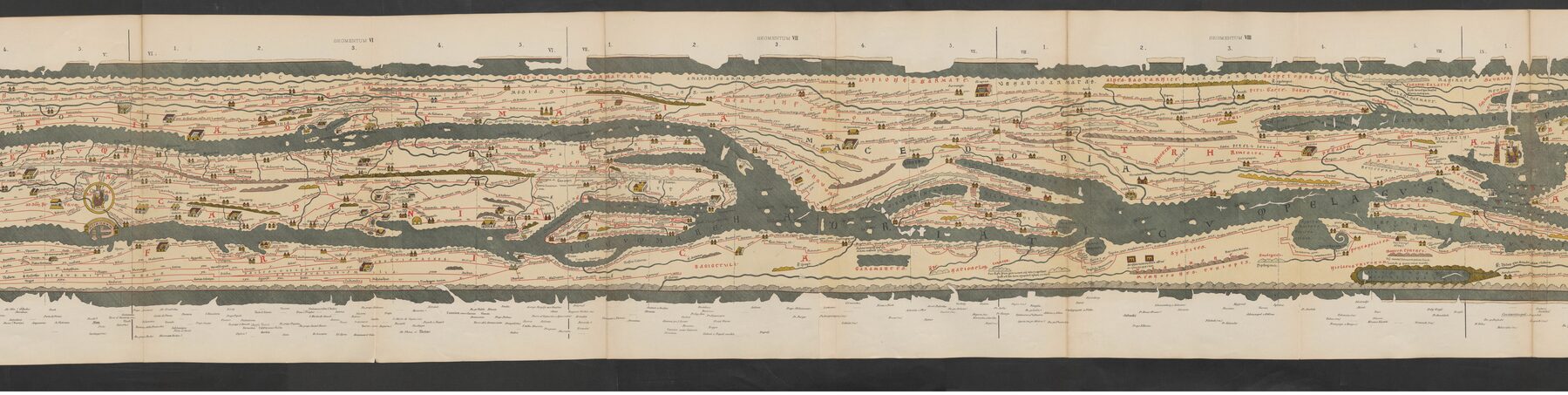
The Tabula Peutingeriana is not trying to be a scaled geographic copy. Its distortion preserves what travelers needed: roads, stations, and sequence.
So a model is not a small true copy of the world. It is a useful distortion. Michael Weisberg’s Simulation and Similarity gives the precise philosophical version: a model need not be identical to the target, or even perfectly isomorphic to it; it must be similar in the respects that matter, to the degree required by the job.
All models are wrong
George E. P. Box gave statistics its most quotable line: “All models are wrong, but some are useful.” The citation trail is a miniature frontier-calibration lesson. His 1976 paper Science and Statistics contains the seed: because all models are wrong, the scientist cannot obtain a correct one by endless elaboration. The polished aphorism appears as a section heading in a 1979 conference chapter, and the now-familiar version that begins “Essentially, all models are wrong…” appears in the 1987 textbook he wrote with Norman Draper.
Three dates, one idea sharpening over a decade. The aphorism is real; the casual citation often attached to it is not. Check the sources; we will do that at scale on Day 149.
A joke older than Borges
Borges was not first to the one-to-one map. In Lewis Carroll’s Sylvie and Bruno Concluded (1893), a character boasts of a national map on the scale of “a mile to the mile.” Why was it never unrolled? The farmers objected, because it would block out the sun and kill the crops. So they use the country itself as its own map. The territory is always its own most accurate model, and also the least useful one.
The craft
The spherical cow, and why scientists simplify on purpose
There is an old joke. A dairy farmer hires physicists to improve milk yield. Months later they return with a solution, but it works only for a spherical cow in a vacuum.
The joke works because it catches something true. Deliberately false assumptions, or idealizations, are not a flaw in science; they are one of its sharpest tools. Galileo’s law of falling bodies is clean only for bodies in a vacuum, with no air resistance, no spin, and an ideal gravitational field. None of that is exactly true. Ernan McMullin called this Galilean idealization: distort the problem to make the mechanism visible, then add detail back if the purpose demands it.
Sometimes the simplification is even deeper. A frictionless plane does not merely make the arithmetic easy; it reveals inertia by removing the thing that hides it. This minimalist idealization is not an approximation of the world so much as an argument about what matters. The spherical cow, the ideal gas, the point mass, the infinite population in genetics, and the frictionless pulley all say: ignore this noise and watch the structure that remains.
“All models are wrong” is therefore not a counsel of despair. It is a counsel of focus. A model that tried to be right about everything would be Borges’s map: total, faithful, and inert. The art is choosing which falsehoods to commit to.
Interactive · fidelity versus usefulness
The Idealization Dial
Drag from a clean schematic toward a near one-to-one replica. Fidelity keeps climbing; usefulness rises, peaks, and then collapses as the model swells back toward the territory itself. The sweet spot is not at either edge.
A chart where fidelity rises and usefulness forms an inverted U.
Fidelity to reality
0.34Usefulness
0.86Load an example
Example · Idealization
The sequence moves from severe abstraction to a one-to-one replica. Fidelity rises as detail increases, but usefulness peaks in the middle and collapses when the model becomes as complicated as the target.
| Region | Example | Lesson |
|---|---|---|
| Too little detail | A point mass for a dairy cow | The simplification has removed the very property you needed. |
| Useful middle | A subway map or ideal gas | The model preserves the structure needed for the task. |
| Too much detail | Borges's one-to-one map | Maximum fidelity can destroy compression, clarity, and use. |
The debate
Do our maps describe a real world, or just work?
Here the practical question becomes one of philosophy’s deepest fights. Physics speaks of electrons, quarks, fields, and spacetime curvature: entities and structures not observed in the ordinary direct way, but known through instruments, intervention, and inference. The theories work spectacularly. Does that success mean the unobserved constituents of the world are really there, more or less as described? Or are electrons markers in a powerful predictive system, empirically adequate without telling us what reality is like underneath?
The scientific realist says success would be miraculous if our best theories were not latching onto reality. This is the no-miracles argument associated with Hilary Putnam and J. J. C. Smart: truth is the best explanation for sustained predictive success.
The anti-realist reply comes from history. Larry Laudan’s 1981 paper A Confutation of Convergent Realism lists theory after theory that was successful in its day and false in ours:
- Phlogiston: the fire-stuff supposedly present in combustibles.
- Caloric: heat treated as an invisible fluid.
- The luminiferous ether: the medium light supposedly waved through.
- Crystalline spheres: the shells that carried the planets.
- Vital forces: the special spark of living matter.
The punch is brutal. Past success did not guarantee reference to real entities. Why assume our current success finally does? This is the pessimistic meta-induction. Add underdetermination and the realist has a serious problem: more than one map can fit the same ground.
Four ways to live with the tension
Most philosophers do not camp at the poles. They ask a narrower question: after prediction succeeds, what do we actually have reason to believe? The four positions below all respect working models. They disagree about whether successful maps support belief in approximate truth, surviving structure, manipulable entities, or only observable adequacy.
| Position & anchor | Observable predictions | Unseen entities | Mathematical structure |
|---|---|---|---|
| Scientific realismPutnam · Smart · no miracles | ✓Evidence for approximate truth | ✓Often real, approximately described | ✓Often tracks real relations |
| Structural realismWorrall 1989 · best of both worlds | ✓Evidence that some structure is preserved | ~Entity claims held more loosely | ✓Structure is the main survivor |
| Entity realismHacking; with Cartwright-style law skepticism | ✓Prediction matters, but intervention matters more | ✓Believe in entities we can manipulate | ×Grand laws may be idealized or local |
| Constructive empiricismvan Fraassen 1980 | ✓Must be empirically adequate | ×Withhold belief | ×Useful representation, not believed as true |
| Position | Observable predictions | Unseen entities | Mathematical structure |
|---|---|---|---|
| Scientific realism | Evidence for approximate truth | Often real, approximately described | Often tracks real relations |
| Structural realism | Evidence that some structure is preserved | Entity claims held more loosely | Structure is the main survivor |
| Entity realism | Prediction matters, but intervention matters more | Believe in entities we can manipulate | Grand laws may be idealized or local |
| Constructive empiricism | Must be empirically adequate | Withhold belief | Useful representation, not believed as true |
Read the table as a set of commitments, not as four slogans. Scientific realism is the first row’s bold answer: sustained success is evidence that a theory has latched onto the world, at least approximately. Laudan’s historical list is why that answer cannot be casual.
Structural realism, the second row, is the most map-like compromise. Look at the ether. Fresnel’s ether disappeared; Maxwell’s electromagnetic field replaced it. But parts of the mathematical structure survived the revolution. Maybe science inherits structure more reliably than full claims about the nature of entities. Keep the equations; hold the entities loosely.
Entity realism, the third row, moves from prediction to intervention. Hacking’s slogan can be put this way: if electrons can be used as tools of experimental intervention, we have reason to believe they are real. This view is realist about entities that can be manipulated to produce effects, while remaining more cautious about the grand theories surrounding them. Cartwright-style law skepticism supplies the complementary warning from How the Laws of Physics Lie: fundamental laws often govern idealized objects in carefully built models, not messy objects in the world.
Constructive empiricism, the final row, refuses the extra step. If a theory saves the observable phenomena, it has done its scientific job; belief in hidden entities is optional. That is why the next section matters. Computers are about to build maps that work astonishingly well while making every row of this table harder to keep tidy.
The frontier · 2026
The old fight, reborn in silicon
For most of history, science had two ways to learn: think about the world and poke the world. In the last few decades, a third has muscled in: simulation. A climate model runs a century in code. A jet engine’s digital counterpart predicts a crack before it forms. On benchmark hindcasts, learned forecasters now beat leading physics-based baselines on some headline metrics. What kind of knowledge is that?
Simulation is not quite theory and not quite experiment. It inherits equations, approximations, data cleaning, numerical schemes, calibration habits, and institutional judgment. Eric Winsberg argues that simulations have their own epistemology: they can produce genuine knowledge, justified by practices that are not reducible to either pencil-and-paper theory or laboratory experiment. Paul Humphreys named the unease epistemic opacity. A process may be formally specified and still too large for any human to inspect step by step. That opacity was already present in large simulations; neural models make it harder to ignore.
When does a model earn the name?
Digital twin has become marketing language, so use the strict source: the 2024 U.S. National Academies report Foundational Research Gaps and Future Directions for Digital Twins. Under that bar, a twin is not merely a simulation. It is a virtual construct tied to a physical counterpart, updated by data from that counterpart, capable of prediction, and used to shape decisions about the system it represents. The feedback loop is the bar.
The hard problem is trust. The report emphasizes VVUQ as a continual process, not a one-time stamp. The physical system changes, data change, decisions change, and the twin must be re-validated as it moves. That is also the report’s frontier calibrator: separate a true bidirectional twin from an ordinary simulation, and separate an aspirational twin from one that actually exists.
This is where the name becomes expensive. A high-resolution CAD model is not enough. A dashboard fed by sensors is not enough. A simulation you rerun after manually uploading yesterday’s data may be useful, but it has not yet earned the full name. The strong case is a loop: the physical system updates the virtual one; the virtual system forecasts and tests options; a decision changes the physical system; the next data stream checks whether the model is drifting. Without that loop, “twin” is mostly metaphor.
A digital twin of the whole planet
The most ambitious version is Europe’s Destination Earth program, built with ECMWF, ESA, and EUMETSAT. On 10 June 2024, its first system release brought two high-priority twins online from the LUMI Supercomputer Center in Kajaani, Finland: Weather-Induced Extremes and Climate Change Adaptation. That matters because the phrase moved from policy vision to running infrastructure. The current Weather-Induced Extremes twin describes a 4.4 km global component, with 500-750 m regional European capability; earlier demonstrations and release materials used other km-scale configurations.
That is an established launch milestone, not a magic planet-copy. It is not yet the science-fiction object implied by the phrase “digital twin of Earth.” Higher resolution can expose new structure, but it also raises hard questions about parameterization, data assimilation, verification, cost, and whether the extra detail improves the decision at hand. The European goal of a full Earth-system twin by 2030 remains a roadmap.
So the verdict has two halves. DestinE is real infrastructure: observations, high-performance computing, Earth-system models, and decision-facing services brought into one program. But “whole Earth twin” remains a future-tense label. The epistemic question is not whether the picture looks more detailed. It is whether the extra detail improves the relevant decision, under quantified uncertainty, for the task the twin is being asked to serve.
Clinical twins: a narrow cousin that works
Medicine loves the idea of a digital twin of you: a running model of your body on which doctors could test interventions. The clinical literature is far thinner. The National Academies report treats biomedical twins as a frontier with large research gaps, not a finished clinical platform. A 2025 scoping review in npj Digital Medicine found that only 18 of 149 healthcare studies using the label fully met the National Academies definition, and only two mentioned VVUQ.
The narrow cousin proves the rule. HeartFlow’s FFR-CT takes a coronary CT scan and builds a patient-specific computational-fluid-dynamics model of blood flow to assess whether a blockage is starving the heart. It received FDA De Novo clearance in 2014. The scope is narrow, physical, and decision-specific: one organ system, one imaging moment, one clinical question. That is why it works. But it is not a clean full digital twin under the strict National Academies definition: the CT-derived model represents a patient at the time of imaging; it is not a dynamically updating, bidirectional virtual-physical loop. Its success shows how powerful a constrained patient-specific model can be, and why the full-body twin is a much larger claim. The broader FDA credibility framework points the same way: its 2023 guidance is for physics-based, mechanistic, or first-principles computational models in device submissions, not standalone machine-learning or AI models.
The epistemic bargain is narrow but strong. Trust comes from anatomy, CT acquisition, fluid mechanics, validation against clinical endpoints, and a regulatory question small enough to audit. Stretch the same language from “this artery, this scan, this flow calculation” to “this whole patient, all future interventions,” and the confidence does not scale with the metaphor. The more a medical twin claims to include, the more VVUQ has to do.
Forecasting weather without hand-coding the forecast equations
For decades, weather forecasting meant solving atmospheric physics on enormous computers. Then machine-learning models trained on reanalysis and past weather caught up with, and on several benchmark hindcasts surpassed, leading physics-based systems. GraphCast, Pangu-Weather, and GenCast are not press-release curiosities; their central findings were published in Science and Nature. The qualifier matters: these are benchmark hindcasts and target metrics, not proof of universal operational superiority.
They also do not begin from pure ignorance. Reanalysis data already carries instruments, data assimilation, and earlier physical modeling inside it. So the phrase “without hand-coding the forecast equations” needs a precise reading: the learned forecaster is not advancing the atmosphere by explicitly solving the usual forecast equations step by step. It has inherited physical structure through the data pipeline, then learned a powerful map from past states to future states.
Read the three claims carefully. GraphCast reported outperforming a leading deterministic system on about 90% of 1,380 verification targets. GenCast reported greater skill than ECMWF’s ensemble forecast on 97.2% of 1,320 targets. Pangu-Weather’s headline is different: forecast-time and runtime gains against IFS-style baselines, not a share-of-targets percentage. The shared lesson is not that physics has been abolished. It is that learned maps can become astonishingly good at the task of forecasting before they become satisfying explanations.
The philosophical sting is sharp. By headline forecast-skill measures many users care about, these learned systems can be more empirically adequate than the systems built from explicit physical equations. Yet their interiors are opaque weights, not named mechanisms, and real users also care about uncertainty, calibration, extremes, robustness, and operational constraints. A constructive empiricist can shrug: prediction was the goal. A realist should worry more carefully: success alone is a less clean route to realism when the successful model is opaque and trained from prior model/data products.
The structural realist points to the hybrid response. Google’s NeuralGCM keeps a differentiable atmospheric dynamics core and uses machine learning for parts the physics still parameterizes, approximates, or resolves only imperfectly. Keep the trusted structure; learn the closures. That is structural realism as engineering practice. But the caveat matters: like other learned systems, NeuralGCM is not expected to extrapolate far beyond its training regime. Mechanism may be exactly what you need at the edge of the map.
Open questions
What’s genuinely unsettled
- Is simulation a third pillar of science, or applied math with better machines? Winsberg and Margaret Morrison argue for a distinctive epistemology; critics still see expanded modeling.
- Does predict-without-representing weaken scientific realism? If a mechanism-free model can out-forecast a physical one, success alone looks less like evidence for truth.
- Can learned models extrapolate? The weather results are strongest inside regimes represented in training data. Novel climates and rare extremes are the empirical test.
- When does a model deserve the name digital twin? The National Academies drew a strict line. Many products using the phrase do not clear it.
- What happens when the model is an AI system? If a language model produces a true, well-supported claim, is it describing reality or only operating as an empirically adequate map? We return to this in the AI block.
The day in three sentences
- Big idea
- Every model is a deliberate, useful distortion: it preserves structure for a purpose while discarding nearly everything else. The hard question is whether our most successful maps describe a real world or merely save the phenomena.
- Best analogy
- Borges’s one-to-one map and the spherical cow in a vacuum: perfect fidelity can be useless, while a false simplification can reveal exactly what matters.
- Live controversy
- Digital twins and AI weather models reopen scientific realism in silicon, especially when prediction succeeds without a human-readable mechanism.
Threads today › computation (simulation as a third mode of science) · information (models as lossy compression) · emergence (multiscale models and digital twins) · energy and evolution in the idealizations.
Tomorrow → Day 11
Heuristics, Biases & Rationality
Today we watched science simplify the world on purpose. Tomorrow the lens turns inward: the mind itself runs on shortcuts. Meet Linda the bank teller, System 1 and System 2, and the rationality wars over whether heuristics are flaws to correct or adaptive bets under scarcity.
Sources
Sources & further reading
- Korzybski, A. (1933). Science and Sanity: An Introduction to Non-Aristotelian Systems and General Semantics. Map-territory relation, p. 58. archive.org page image
- Borges, J. L. (1946). “Del rigor en la ciencia” / “On Exactitude in Science.” Original publication listed by the Borges Center, Los Anales de Buenos Aires 1.3 (March 1946), p. 53. borges.pitt.edu/bibliography/1946-1
- Carroll, L. (1893). Sylvie and Bruno Concluded, ch. XI, “The Man in the Moon.” Lit2Go chapter text
- Box, G. E. P. (1976). “Science and Statistics.” Journal of the American Statistical Association 71(356): 791-799. doi:10.1080/01621459.1976.10480949
- Box, G. E. P. (1979). “Robustness in the Strategy of Scientific Model Building,” in Launer & Wilkinson (eds.), Robustness in Statistics, 201-236; aphorism as section heading, p. 202.
- Box, G. E. P. & Draper, N. R. (1987). Empirical Model-Building and Response Surfaces. Wiley; “Essentially” wording, p. 424.
- Weisberg, M. (2013). Simulation and Similarity: Using Models to Understand the World. Oxford University Press.
- McMullin, E. (1985). “Galilean Idealization.” Studies in History and Philosophy of Science 16(3): 247-273.
- Putnam, H. (1975); Smart, J. J. C. (1963). See Stanford Encyclopedia of Philosophy, “Scientific Realism.” plato.stanford.edu/entries/scientific-realism
- Laudan, L. (1981). “A Confutation of Convergent Realism.” Philosophy of Science 48(1): 19-49. jstor.org/stable/187066
- van Fraassen, B. C. (1980). The Scientific Image. Oxford University Press.
- Worrall, J. (1989). “Structural Realism: The Best of Both Worlds?” Dialectica 43(1-2): 99-124.
- Hacking, I. (1983). Representing and Intervening. Cambridge University Press.
- Cartwright, N. (1983). How the Laws of Physics Lie. Oxford University Press.
- Winsberg, E. (2010). Science in the Age of Computer Simulation. University of Chicago Press. Humphreys, P. (2009), on epistemic opacity.
- National Academies of Sciences, Engineering, and Medicine. (2024). Foundational Research Gaps and Future Directions for Digital Twins. doi:10.17226/26894. nationalacademies.org/read/26894
- European Commission / ECMWF. Destination Earth system launch, 10 June 2024, including launch from the LUMI Supercomputer Center; Weather-Induced Extremes Digital Twin current resolution description. destination-earth.eu · destine.ecmwf.int launch note · destine.ecmwf.int/weather-induced-extremes-digital-twin
- Tudor, Burton, et al. (2025). “A scoping review of human digital twins in healthcare applications and usage patterns.” npj Digital Medicine 8: 587. doi:10.1038/s41746-025-01910-w
- FDA. HeartFlow FFR-CT De Novo DEN130045, decision date 26 November 2014; De Novo database entry and decision summary. FDA 2023 final guidance on assessing computational modeling and simulation credibility in medical device submissions. De Novo entry · decision summary · FDA guidance · FDA program summary
- Lam, R. et al. (2023). “Learning skillful medium-range global weather forecasting.” Science 382(6677): 1416-1421. doi:10.1126/science.adi2336
- Bi, K. et al. (2023). “Accurate medium-range global weather forecasting with 3D neural networks.” Nature 619: 533-538. doi:10.1038/s41586-023-06185-3
- Price, I. et al. (published online 2024; issue 2025). “Probabilistic weather forecasting with machine learning.” Nature 637: 84-90. doi:10.1038/s41586-024-08252-9
- Kochkov, D. et al. (2024). “Neural general circulation models for weather and climate.” Nature 632: 1060-1066. doi:10.1038/s41586-024-07744-y
Deep dive appendixThe Cutting-Room FloorOptional extension.
The main descent ran a straight line: from Borges’s empire-sized map, through the spherical cow, into the realism debate, and out the far end at a neural network that forecasts the weather without human-readable physical equations written inside it. It was a clean arc, and it left an enormous amount on the cutting-room floor. The realism fight is four centuries older than van Fraassen. The craft of “lying usefully” has a precise grammar nobody mentioned. And the strangest question of all, how do you trust a model whose innards no human can survey?, loops all the way back to Day 1.
What's down here
You can skip this; it adds historical and philosophical detail to the main argument.
Six rooms the main tour skipped: (1) the older war between realism and instrumentalism; (2) the ether’s one triumphant prediction, and how realism fights back with “divide and conquer”; (3) why the whole realism debate may be a base-rate fallacy, a straight callback to Day 4; (4) the real grammar of idealization, and Levins’s “pick two” triangle; (5) what models actually are: mediators, fictions, and Maxwell’s imaginary gears; and (6) the trust problem, from verification’s 1994 bombshell to “computational reliabilism,” which is just Day 1’s reliabilism wearing a lab coat.
Room Ithe long prehistory
Saving the phenomena: an argument four centuries deep
The main lesson framed realism versus instrumentalism as a twentieth-century affair: Putnam, Laudan, van Fraassen. But the fight is ancient, and for most of its life the instrumentalists were winning. The tradition even has a battle cry, handed down from Greek astronomy: sōzein ta phainomena, “to save the phenomena.” The job of a model, on this old view, was never to say what the heavens are, only to reproduce what they appear to do, to get the dots in the right places on the right nights.
Ptolemy’s epicycles, wheels turning on wheels to explain the planets’ loop-the-loops, were the original useful fiction. Many of his readers, and most medieval astronomers, treated them frankly as calculating devices. Nobody had to believe the sky was full of literal gears. The gears just had to work. That is instrumentalism in its cradle, a thousand years before the word existed.
The drama sharpened with Copernicus. When On the Revolutions of the Heavenly Spheres went to press in 1543, the Lutheran theologian Andreas Osiander slipped an unsigned preface into the front, without the dying Copernicus’s blessing, assuring readers that the wild new sun-centered scheme need not be true, only a convenient hypothesis for computing positions. It was a peace treaty with the authorities, written in pure instrumentalist ink: relax, it is just a better calculator.
The cardinal was an instrumentalist
The cleanest statement of the divide comes from Galileo’s own prosecutor. In 1615, Cardinal Robert Bellarmine told the Copernican Paolo Foscarini that one could hold heliocentrism perfectly well ex suppositione, hypothetically, as a device that saves the appearances, but not as a claim about how the world physically is. Speak of it as a model, fine. Speak of it as the truth, and you have a problem. Bellarmine’s stated position reads like instrumentalism, though the historical conflict was more than a philosophy seminar. Galileo’s danger was treating the model as physically true, not merely computationally convenient. The same fault line runs straight through to the neural weather model in the main lesson.
By the early 1900s the physicist-philosopher Pierre Duhem, whom we met on Day 2 for the “you can always blame an auxiliary” thesis, had turned this into a full doctrine. A physical theory, Duhem argued in The Aim and Structure of Physical Theory (1906), is not an explanation of hidden reality but an economical classification of experimental laws: a supremely compressed filing system for the phenomena. Truth about unseen causes was not the goal. Tidy, predictive bookkeeping was. Three hundred years of “save the phenomena,” distilled. The modern instrumentalist owes Duhem the blueprint.
Room IIrealism strikes back
The ether’s one perfect prophecy
The main lesson used the luminiferous ether as Exhibit A in Laudan’s graveyard, a wildly successful theory whose central object turned out not to exist. But the ether’s case is far more disturbing than a simple “it worked, then it died,” and the reason is a single beautiful episode that the realist keeps in her back pocket.
Around 1818, the French Academy ran a prize competition on the nature of light. Augustin Fresnel submitted his wave theory: light as vibrations in the ether. On the judging panel sat Siméon Denis Poisson, a committed believer in the rival particle theory, who did some math with Fresnel’s equations and triumphantly derived an apparently absurd consequence. If Fresnel were right, the shadow of a small round disc should have a bright spot dead in its center, where the waves bending around every edge arrive back in step. Ridiculous, said Poisson: a clear reductio that sinks the whole wave theory. Another judge, François Arago, went to the bench and actually did the experiment. The spot was there.
This is the realist’s haymaker, and it has a name: a novel prediction. The ether theory did not merely accommodate facts already known. Anyone can curve-fit the past. It predicted something nobody had ever seen and no one expected, a detail so specific and strange that its coming true looks like no coincidence at all. This is the no-miracles argument from the main lesson at full strength: surely a theory cannot pull a rabbit like that out of a hat unless it has hold of something real. And yet there is no ether. The single best evidence realism ever assembled was produced by a theory we now call false. The graveyard, it turns out, contains a genius.
Divide and conquer
So how does the realist survive her own best example? With a move sometimes called selective, or divide-and-conquer, realism, sharpened by Philip Kitcher and Stathis Psillos in the 1990s. The trick is to stop being a realist about whole theories and become one about parts. In any successful theory, only some posits actually do the predictive heavy lifting: the working posits. Others are idle, along for the ride. Be a realist only about the working parts.
Run the ether through this filter and watch it sort itself. What did the real work in deriving Poisson’s spot? Not the substance “ether,” not its density, its elasticity, or the question of what it was made of. The work was done by the mathematical form of the wave equations: the relationships, the structure. And those carried over into Maxwell’s field theory and beyond. The idle metaphysical filler, the stuff of the ether, is exactly what got buried. So the pessimistic induction loses some of its teeth. Science did not preserve the full claims about what the entities were; it kept the structure, which survived revolution, and quietly dropped the idle metaphysics. This is precisely the structural realism the main lesson ended on, now shown doing real work against its hardest case.
Room IIIthe callback to Day 4
Is the whole debate a base-rate fallacy?
Here is the room that should make a Day 4 graduate sit up. Recall the base-rate fallacy: a test that is 99% accurate for a disease that afflicts 1 in 10,000 still flags far more healthy people than sick ones, because you forgot to ask how common the disease is to begin with. Confusing P(positive | sick) with P(sick | positive) is the classic trap.
In 2004, the philosophers P. D. Magnus and Craig Callender pointed out that both sides of the realism war may be walking straight into it. Look again at the no-miracles argument. It wants to conclude that a successful theory is probably true, that is, that P(theory true | theory successful) is high. But by Bayes’ theorem, you cannot get there from P(success | truth) alone. You also need the base rate: the prior proportion of true theories in the pool of candidate theories science draws from. And that number is not just unknown. Magnus and Callender argue that it is unknowable, because there is no fair way to count or sample all candidate theories that could have existed for mature sciences. No base rate, no inference.
The same blade cuts the pessimistic induction, which tries to push P(theory true | success) low from the historical record of failures, and trips over the same missing denominator. Magnus and Callender’s diagnosis is almost clinical: framed probabilistically, the grand “wholesale” arguments are not just unresolved; they may be malformed, each a base-rate fallacy in a frock coat. Colin Howson made a closely related charge against no-miracles in 2000. The Day 4 machinery does not just describe this dispute. It may dissolve the wholesale version of the fight. live dispute
Room IVthe grammar of useful lies
Idealization has rules, and a famous tradeoff
The main lesson treated “deliberately false assumptions” as one thing. The literature is fussier, and the distinctions matter. First, separate two moves people lump together. Abstraction is leaving something out: modeling a planet’s orbit without mentioning its color. True as far as it goes, just silent. Idealization is actively misrepresenting: declaring the plane frictionless when you know full well it is not. The frictionless plane is not a gap in the description. It is a fib. The two feel similar and behave very differently.
Then there are kinds of idealization, and the third one is the one the main lesson skipped. There is Galilean idealization, which distorts for tractability and promises to add detail back later, and minimalist idealization, the spherical cow strategy that keeps only the causal factors thought to matter. But there is also multiple-models idealization: building several mutually incompatible models of the same thing, each false in a different direction, and triangulating among them. No single map is trusted. What deserves trust is the agreement between differently wrong maps.
“Our truth is the intersection of independent lies.”
Levins’s point, now called robustness analysis, is that if you attack a problem with several models built on different simplifying falsehoods, and they all spit out the same qualitative result, then that result probably depends on the real shared structure of the problem rather than on any one model’s particular lie. The lies are independent. Their intersection is where truth is most likely hiding.
Levins is also the source of modeling’s most famous impossibility claim: you cannot maximize generality, realism, and precision all at once. Push any two as far as they will go and the third has to give. The dial in the main lesson measured fidelity against usefulness. Levins’s triangle is the same wisdom in three dimensions: pick your sacrifice.
Modeling tradeoff · Levins’s triangle
No model can maximize all three desiderata. Tap the vertex you are willing to sacrifice; the opposite edge marks the two you keep, and the readout names the strategy and an example. Levins’s own preference was to sacrifice precision for generality and realism.
tap a corner to choose the sacrifice
Robust and qualitative
Keeping: generality + realism; sacrificing: precision
Flexible, often simple models that tell you the direction of change, such as more predators leading to fewer prey. They travel across systems without promising exact numbers.
Example: theoretical ecology and toy economic or physical models that isolate a mechanism without decimal-point claims.
contestedOrzack and Sober (1993) argue that this triangle is not a strict theorem; sometimes one desideratum can improve without an immediate loss in another.
No model can maximize all three desiderata. The figure and table below expand all three tradeoffs.
| Sacrifice | Keep | Strategy | Example |
|---|---|---|---|
| Precision | Generality + realism | Robust qualitative models that capture the direction of change without decimal-point claims. | Theoretical ecology and toy economic or physical models that isolate a mechanism. |
| Realism | Generality + precision | Clean, exactly solvable models built on assumptions known to be false. | Frictionless planes, perfectly rational agents, infinite populations. |
| Generality | Realism + precision | High-resolution models of one specific target, accurate but narrow. | A digital twin of this watershed, this lake, or this patient. |
Orzack and Sober (1993) make that last sentence more careful. Levins’s triangle is a useful warning, not a strict theorem: sometimes a model can gain precision without instantly losing realism, or widen its scope without immediately becoming blurrier. Read the table, then, as an audit prompt rather than a prison. Each row asks which modeling virtue this move most likely gives up. The disciplined question is not which two we keep forever; it is what this simplification clarified, and what it quietly put at risk.
Room Vwhat is a model, really?
Mediators, fictions, and Maxwell’s imaginary gears
Step back and ask the question the main lesson tiptoed around: when a scientist “has a model,” what kind of thing is it? Three answers illuminate different corners.
A theory is a family of models. On the older syntactic picture, a scientific theory was a big set of sentences: axioms and their logical consequences. The modern semantic view says no. A theory is better understood as a collection of abstract structures, together with a claim that some real system is similar to one of them in specified respects. Newtonian mechanics is not fundamentally a wall of equations. It is a toolkit of idealized systems, the pendulum, the two-body orbit, the harmonic oscillator, plus the bet that bits of the world resemble them closely enough. Ronald Giere called the resulting stance perspectival realism: our models are like instruments, each giving a partial, perspective-bound view, true to the world the way a map is true, never the way a mirror is.
Models are mediators. In the influential 1999 collection Models as Mediators, Mary Morgan and Margaret Morrison argued that models are not simply read off from theory, nor simply summaries of data. They sit between, partly autonomous from both. You build a model the way you build an instrument, making pragmatic choices theory does not dictate; then, crucially, you learn by manipulating it, the way you learn by turning the knobs on an apparatus. A model is a tool you think with, not just a picture you look at. This is also why simulation, in the next room, can feel so much like experiment.
Models are fictions. The most radical view takes the frictionless plane at its word: it is a fiction, an object that does not exist, described as if it did. The idea is old. Hans Vaihinger’s 1911 The Philosophy of “As If” argued that whole swathes of science and mathematics run on useful falsehoods we knowingly treat as if true. Recall the Day 3 surprise that Sherlock Holmes’s “deductions” are really abductions: here is its cousin. A scientific model may be closer to a character in a novel than to a photograph. The ideal gas is a bit like Sherlock: not real, never was, but reasoning about what it would do delivers real understanding.
The man who built a machine he knew was false
The patron example sits next to the main lesson’s Fresnel-to-Maxwell story. To derive his immortal equations of electromagnetism, James Clerk Maxwell first built an outrageous mechanical contraption: a space packed with spinning “molecular vortices,” separated by little rolling “idle wheels.” He did not believe space was full of gears. He called it an illustration, a fiction to think with. Out the other end came Maxwell’s equations: structure that was true, midwifed by a model that was false. His mentor Lord Kelvin took the creed to the hilt: “I never satisfy myself until I can make a mechanical model of a thing.” The fiction was scaffolding. The structure was the keeper. That is the whole of Day 10 in one Victorian anecdote.
Cartwright’s dappled world
Cartwright pushes this point further, deepening the entity realism from the main lesson. Nancy Cartwright, who gave us “the laws of physics lie,” built that thought into a whole worldview in The Dappled World (1999). Her claim: fundamental laws are true only inside models, and they describe the real world only where we have painstakingly engineered, or luckily found, a nomological machine: a shielded, stable, repeating arrangement of parts that produces lawlike regularity. A physics lab is such a machine. So is the solar system, roughly.
But most of the world is not shielded or stable, and there the tidy laws simply do not reach. They hold only ceteris paribus, all else equal, and all else is never equal. The world, for Cartwright, is not a pyramid with grand laws at the base but a patchwork: a dappled quilt of little domains where different models work and between which nothing universal runs. Read her way, “all models are wrong” stops being a remark about our maps and becomes a claim about reality: the laws themselves were idealizations all along. live position
Room VIthe trust problem
Verifying the unsurveyable, and a bombshell from 1994
Engineers who stake lives on simulations drew a hard distinction long ago. Verification asks: did we solve the equations right? Is the code a faithful numerical solution of the model we wrote down? Validation asks the harder thing: did we solve the right equations? Does the model actually correspond to the world? Solve-it-right versus solve-the-right-thing. Almost every dispute about trusting a model is really a dispute about validation.
And then, in 1994, three researchers detonated a small bomb under the word itself. In Science, Naomi Oreskes, Kristin Shrader-Frechette, and Kenneth Belitz argued that for models of open natural systems, climate, groundwater, ecosystems, verification and validation are impossible in principle. Their reasoning lands on three course threads at once. Natural systems are never closed, so you can never control all the inputs. Model solutions are non-unique, so a good fit never proves your model is the right one, which is the underdetermination from the main lesson. And confirming a model by matching its predictions to data is, strictly, the fallacy of affirming the consequent from Day 3: if my model is right, I will see X; I see X; therefore my model is right. Their verdict on the word “validation” is severe: it falsely implies a legitimacy the model cannot earn. The primary value of models, they argued, is heuristic. They are instruments for thinking, not certificates of truth. established
So how do we trust the black box?
This is where the main lesson’s neural weather model comes back to haunt us. If you cannot validate a model of an open system in the strong proof-of-truth sense, and you cannot even survey the billions of weights inside a learned emulator, Humphreys’s epistemic opacity from the main lesson, then on what grounds could you ever trust its forecast?
Juan Durán and Nico Formanek proposed one answer in 2018: computational reliabilism. Stop and feel the click. Reliabilism was Day 1: the idea that a belief is justified not because you can recite an argument for it from the inside, but because it was produced by a reliable process, such as good vision or sound memory. Durán and Formanek point that externalist answer at simulations. You do not need to see inside the opaque model to trust its output; you need evidence that the process producing it is reliable.
That evidence looks like a track record of verification and validation where checking is possible, robustness across independent methods, a history of the technique succeeding where it could be checked, and the judgment of experts who know its failure modes. Trust migrates from transparency to reliability. The black box can be known the way a witness can be known: not by cracking open the skull, but by examining the record. The thing that defined a justified belief in a human brain on Day 1 turns out to define a trustworthy answer from a machine on Day 10. debated
Bonus room
Where “digital twin” actually came from
The main lesson leaned on the 2024 National Academies definition: bidirectional, continually updated, predictive. Where did that idea come from, and what makes the strict definition matter?
The ancestor flew on Apollo. NASA built physical twins of its spacecraft and kept them on the ground. When Apollo 13’s oxygen tank ruptured 200,000 miles from home, engineers fed live telemetry into ground-based simulators and physical mockups to improvise fixes for a craft they could not touch. A model on Earth, updated with data from its endangered counterpart in space, used to make a life-or-death decision: that is the platonic form of a digital twin, decades before the phrase existed.
The modern concept was laid out by Michael Grieves in 2002, in a University of Michigan product-lifecycle lecture: a slide already showing real space, virtual space, and data flowing both ways between them. The catchy name came later. NASA’s John Vickers coined “Digital Twin” around 2010, and it entered NASA’s technology roadmap. From about 2014, Siemens, Dassault, GE, ANSYS, and the rest stamped it across their marketing, which is exactly why a strict definition became necessary, and why the National Academies drew the line where they did.
That line is best seen as a three-rung ladder, following Kritzinger and colleagues (2018): what earns the name “twin” is not how detailed the model is, but how the data flows.
The taxonomy is deliberately austere. A plain digital model can be enormous and beautiful; a true twin can be visually boring. The difference is the loop.
Diagram · what earns the name
Digital model -> digital shadow -> digital twin
The only thing that changes across the three is the data link between the physical object and its virtual copy. Dashed means manual or absent; solid means automatic.
Digital model
no automatic link
A CAD drawing or stand-alone simulation. You update it by hand, if at all. Many marketed twins are really just this.
Digital shadow
one-way automatic
Live sensor data flows automatically from the physical object into the model, but the model cannot act back. Think live dashboard.
Digital twin
bidirectional automatic
Data flows automatically both ways: the model mirrors the object and steers it. Only this rung earns the strict name.
Bonus room
A model of a model of a model
One last vista reframes the whole frontier. The main lesson set up a contrast between clean physics-based models and messy black-box machine-learning emulators, sharper in the telling than in reality. Two facts blur it.
First: “physics-based” climate models are not pure first principles either. They cannot resolve a cloud or a thunderstorm, because those are far smaller than the grid, so they fake the small stuff with parameterizations: simplified stand-ins whose knobs are tuned until the model reproduces the climate already observed. Climate scientists openly call this “the art and science of climate model tuning.” A model hand-tuned to match known climate, then trusted to predict an unknown one, is leaning on exactly the kind of fit that Oreskes warned cannot validate anything. The principled model has fudge in it too.
Second: when a simulation is itself too expensive to run thousands of times, scientists build a cheap statistical stand-in for the simulation, called an emulator or surrogate. Follow the chain: the world is approximated by a simulation, a model of the world, which is approximated by an emulator, a model of the model. Each rung is faster, cheaper, and a little more wrong. The AI weather models from the main lesson are simply the newest, most powerful rung of that ladder: surrogates that learned to mimic decades of atmosphere directly. “All models are wrong” turns out to be recursive. We routinely build wrong models of our wrong models, and the trick, every time, is knowing which lie is good enough for the job in hand.
Zoom all the way out and the day sits on a four-step staircase that the computer scientist Jim Gray called the four paradigms of science.
The arc · how science has learned to know
The four paradigms
Each paradigm did not replace the last. It stacked on top. Today's AI emulators are the fourth, and the realism-versus-instrumentalism question rides up the staircase with them.
Empirical · describe
Observe and record the world. From star charts to Tycho Brahe's notebooks.
Theoretical · explain
Compress observations into laws and equations. Newton, Maxwell, and the birth of the realism debate.
Computational · simulate
When equations are unsolvable by hand, run them on a machine. The third mode, with its own epistemology.
Data-driven · learnyou are here
Let models learn patterns directly from oceans of data, often with no explicit theory inside. GraphCast, GenCast, and NeuralGCM.
Framed after Jim Gray, The Fourth Paradigm (Microsoft Research, 2009). The fourth rung is precisely where an instrumentalist feels at home and a realist feels uneasy, which is why this thousand-year-old argument suddenly matters for a weather app.
Coda
The aphorism, audited
Let us give the day’s slogan the same scrutiny we gave everything else. “All models are wrong, but some are useful” is true, but it has hardened into a thought-terminating cliché, a phrase people reach for to wave away the hard question instead of answering it. The real questions are the ones it skips: wrong how? Wrong for what? Some models are vastly wronger than others, and the difference between a useful map and a misleading one is the entire game. Statisticians like Andrew Gelman have pushed back precisely here. The aphorism, taken as a shrug, can excuse sloppy work and dull the urge to check.
George Box himself was no nihilist about it. The same papers that gave us “all models are wrong” warn just as hard against the opposite error: mistaking the model for the world, or “worrying about the wrong things” because you have fallen in love with your own elaboration. The discipline he was pointing at is not “models are wrong, so relax.” It is the harder thing this course is built around: calibrated judgment about the specific gap between this map and this purpose. A good modeler is not someone who has stopped lying. It is someone who knows exactly which lie they are telling, and exactly what it is good for.
The appendix in three sentences
Big idea: the realism-versus-instrumentalism fight is four centuries old, may be a base-rate fallacy on both sides, and ultimately turns on a trust question answered not by seeing inside a model but by judging the reliability of the process that made it.
Best new analogy: Maxwell deriving true equations from a clockwork of imaginary gears he knew were false: fiction as scaffolding, structure as keeper, paired with Levins’s “intersection of independent lies.”
Sharpest callback: computational reliabilism is literally Day 1’s reliabilism aimed at simulations: you trust an opaque model the way you trust a witness, by its record rather than by cracking it open.
Threads gathered computation, simulation, and emulation as modes three and four of science · information as compression and robustness as independent evidence · emergence in Cartwright’s patchwork world and tuning across scales · all braided back through Days 1-4.
Sources & further reading
- Duhem, P. (1906). The Aim and Structure of Physical Theory. Theory as economical classification, not explanation. See also Duhem, To Save the Phenomena (1908).
- Osiander’s anonymous preface to Copernicus, De revolutionibus orbium coelestium (1543); Cardinal Bellarmine’s 1615 letter to Foscarini. See Stanford Encyclopedia of Philosophy, “Scientific Realism.” plato.stanford.edu/entries/scientific-realism
- The Arago/Poisson bright spot: French Academy prize competition, c. 1818-1819; Fresnel’s wave theory and the predicted-then-observed spot in a circular shadow. See Kipnis, N. (1991), History of the Principle of Interference of Light, and a concise modern demonstration note from UCSB. web.physics.ucsb.edu
- Psillos, S. (1999). Scientific Realism: How Science Tracks Truth. Routledge. Divide-and-conquer realism; working versus idle posits. Kitcher, P. (1993). The Advancement of Science.
- Magnus, P. D. & Callender, C. (2004). “Realist Ennui and the Base Rate Fallacy.” Philosophy of Science 71(3): 320-338. philpapers.org/rec/MAGREA-2 See also Howson (2000), Hume’s Problem.
- Levins, R. (1966). “The Strategy of Model Building in Population Biology.” American Scientist 54(4): 421-431. Generality/realism/precision tradeoff, robustness, and “our truth is the intersection of independent lies.” Critique: Orzack & Sober (1993), American Naturalist 148:201.
- Morgan, M. & Morrison, M., eds. (1999). Models as Mediators. Cambridge University Press.
- Giere, R. N. (1988/2006). Explaining Science; Scientific Perspectivism. University of Chicago Press. The semantic/model-based view and perspectival realism.
- Vaihinger, H. (1911). Die Philosophie des Als Ob (The Philosophy of “As If”, English trans. 1924). Useful fictions. See also Frigg & Hartmann, “Models in Science,” Stanford Encyclopedia of Philosophy. plato.stanford.edu/entries/models-science
- Maxwell, J. C. (1861-62). “On Physical Lines of Force.” Philosophical Magazine. The mechanical vortex and idle-wheel model of the electromagnetic field.
- Cartwright, N. (1999). The Dappled World: A Study of the Boundaries of Science. Cambridge University Press. Nomological machines, ceteris paribus laws, and the patchwork world.
- Oreskes, N., Shrader-Frechette, K. & Belitz, K. (1994). “Verification, Validation, and Confirmation of Numerical Models in the Earth Sciences.” Science 263(5147): 641-646. doi:10.1126/science.263.5147.641. science.org
- Durán, J. M. & Formanek, N. (2018). “Grounds for Trust: Essential Epistemic Opacity and Computational Reliabilism.” Minds and Machines 28(4): 645-666. doi:10.1007/s11023-018-9481-6. link.springer.com
- Grieves, M. (2002 concept; 2014 white paper “Digital Twin: Manufacturing Excellence through Virtual Factory Replication”); John Vickers/NASA technology-roadmap usage around 2010; Grieves & Vickers, “Origins of the Digital Twin Concept” (2016).
- Kritzinger, W. et al. (2018). “Digital Twin in manufacturing: A categorical literature review and classification.” IFAC-PapersOnLine 51(11): 1016-1022. Digital model / digital shadow / digital twin by data-flow automation.
- Kennedy, M. C. & O’Hagan, A. (2001). “Bayesian calibration of computer models.” Journal of the Royal Statistical Society B 63(3): 425-464. Gaussian-process emulators and surrogates of expensive simulators.
- Hourdin, F. et al. (2017). “The Art and Science of Climate Model Tuning.” Bulletin of the American Meteorological Society 98(3): 589-602.
- Hey, T., Tansley, S. & Tolle, K., eds. (2009). The Fourth Paradigm: Data-Intensive Scientific Discovery. Microsoft Research. Jim Gray’s empirical -> theoretical -> computational -> data-driven framing.
- On “all models are wrong” as cliché: Andrew Gelman, “Statistical Modeling, Causal Inference, and Social Science” (blog, various), and the nuance in Box’s own 1976/1979 papers.
Deep dive appendixThe Edge of the MapOptional extension.
Old mapmakers had a useful convention: where surveys stopped and rumor began, they drew monsters and wrote hic sunt dracones — here be dragons. The main day and Appendix I mapped relatively settled country: Borges, Bellarmine, verification, reliabilism, and the old realism fight. This appendix sails off the edge. Most of what follows is from 2020 or later, much of it from the last few years, and a good share of it will turn out to be wrong. That is the point. The frontier is where calibration matters most.
Read this first
You can skip this; it adds frontier examples and source-calibration detail to the main argument.
Every claim below carries a tag. established means peer-reviewed, reproduced, or hardware-validated. promising means credible but early, narrow, or still preprint-shaped. contested means the evidence is thin, the framing is inflated, or independent review has already deflated the claim. The Day 10 skill — calibrated judgment about how wrong a model is, and for what — is exactly the skill needed to read this frontier.
The shift
From building a model to summoning one
The deepest post-2020 change is not any single result. It is a change in what a scientific model is made of. For four centuries, the usual recipe was explicit: choose idealizations, write equations, solve them. Since about 2022, a rival recipe has been spreading. Train a giant neural network on a staggering amount of domain data until it absorbs the statistical shape of the field, then fine-tune that one model for many concrete tasks.
These systems are foundation models, and importing them into science is one of the decade’s major stories. Wang and 41 co-authors’ 2023 Nature review, “Scientific discovery in the age of artificial intelligence,” reads like a flag planted on new territory. review
The flagship Earth-system instance arrived in May 2025: Aurora, a 1.3-billion-parameter model from Microsoft Research and collaborators, pretrained on more than a million hours of geophysical data. It is not tuned for one job; it is a general pretrained atmosphere that can be fine-tuned for air quality, ocean waves, tropical-cyclone tracks, and high-resolution weather. The paper reports that Aurora matches or beats numerical air-pollution simulations on 74% of targets, wave models on 86% of variables, and official five-day tropical-cyclone track forecasts across several agencies, including the U.S. National Hurricane Center basins. Its authors frame this as the first time a machine-learning model surpassed full operational tropical-cyclone forecasts up to five days. established
Notice what this does to the main lesson’s realism debate. Aurora is constructive empiricism industrialized: a model with no human-readable meteorology inside can still be empirically adequate for important forecasting tasks. The realist’s discomfort — a model that predicts without representing in a surveyable way — is now an active research program, not a classroom puzzle.
The same pattern is spreading. NASA and IBM’s Prithvi WxC, released in 2024 as open weights plus preprint, is a 2.3-billion-parameter weather-climate foundation model trained on MERRA-2 variables and tested across forecasting, downscaling, gravity-wave flux parameterization, and extremes. The gap between released and validated is the reason the hype filter exists. preprint
The map of the frontier
Thirteen dragons, sorted
Before we go deeper, put the whole frontier on one chart. The useful question is not “is this impressive?” It is the two-dimensional question: how established is it, and how much would it matter if it held up? Those axes carve the field into meaning. The upper-right is the real revolution: big and solid. The upper-left is where the dragons live: enormous claims resting on thin ice. The lower-right is less glamorous but often more useful: narrow claims that already carry weight.
Interactive · the frontier on two axes
Impact if true x evidence
Positions are deliberate judgment calls, not measurements. Filter by tag, then tap a numbered point or name for the receipt.
higher = would reshape the field; righter = better evidenced
Deep-RL controllers shaped and stabilized real plasma on the TCV and DIII-D tokamaks. Live hardware validation makes this one of the most established frontier AI cases.
Frontier map · impact if true x evidence
Positions are judgment calls, not measurements. Numbered points are unpacked in the receipts table below.
Frontier receipts
The table below keeps all thirteen receipts visible.
| # | Work | Status | Why it sits there |
|---|---|---|---|
| 1 | Tokamak plasma control | established | Deep RL shaped plasma on TCV and reduced tearing-instability risk on DIII-D: real hardware, high impact. |
| 2 | Aurora Earth-system model | established | Peer-reviewed multi-task forecasting skill, including five-day operational cyclone tracks; whole-Earth-model rhetoric still needs restraint. |
| 3 | FunSearch | established | LLM plus evaluator found new verifiable mathematical constructions, making the output inspectable rather than opaque. |
| 4 | Leakage crisis | established | Kapoor and Narayanan found leakage failures across 17 fields and 294 papers; its impact is deflationary but field-shaping. |
| 5 | Extrapolation drift | established | NeuralGCM and ACE2 show the hard limit: skill inside the training climate is not guaranteed beyond it. |
| 6 | GNoME materials discovery | promising | The Nature result is real; the practical novelty, usefulness, and synthesizability of headline counts remain contested. |
| 7 | MatterGen | promising | Peer-reviewed generative materials work with a synthesis proof point, but broad materials-design payoff is early. |
| 8 | AI-Descartes / AI-Hilbert | promising | Strong realist direction: recover laws from data plus background theory. Most examples still rediscover known laws. |
| 9 | Prithvi WxC | promising | Open 2.3B-parameter weather-climate model; still preprint-era evidence across downstream tasks. |
| 10 | KANs | promising | A 2024 preprint and 2025 PRX follow-up argue for interpretable scientific discovery; broad superiority over ordinary networks remains unsettled. |
| 11 | AI Virtual Cell | contested | A serious Cell roadmap, not a functioning cell twin. The ambition is huge; the built artifact is not here. |
| 12 | cBottle / Earth-2 | contested | A credible generative climate-emulator preprint wrapped in digital-planet and compression marketing. |
| 13 | The AI Scientist | contested | The autonomous-scientist framing was sharply deflated by independent evaluation: failed experiments, novelty errors, hallucinated results. |
Dispatch 1 · surrogates at the controls
The machine now runs the machine
Some frontier models are already load-bearing in the most literal sense: trusted with expensive hardware and unstable plasma. In 2022, DeepMind and EPFL published a reinforcement-learning controller that shaped the magnetic field of a real tokamak fusion reactor, holding plasma in target configurations on the TCV machine. In 2024, a follow-up used deep reinforcement learning to reduce the risk of tearing instabilities on the DIII-D tokamak. When a learned model is allowed to steer fusion plasma in real time, “just a model” is no longer a useful dismissal. hardware
The same dispatch also carries a warning. Physics-informed neural networks were pitched as a bridge between explicit equations and learned models: bake the differential equation into the loss function, then let the network learn a solution. The failure-mode literature shows the catch. A PINN can drive its residual loss down while the actual solution remains badly wrong. The model can satisfy every constraint you wrote down and still miss the world, because you did not write down all the constraints that matter. failure modes fixes early
Dispatch 2 · the realist counterattack
Discover the law — do not just fit it
If the black-box emulator is instrumentalism’s triumph, a quieter counter-movement fights for the realist. Its demand is simple: do not settle for a model that predicts; make the machine hand you a law you can read. This is symbolic regression and theory-guided discovery.
Three specimens matter. AI-Descartes combines symbolic regression with logical reasoning over background axioms and rederived laws such as Kepler’s third law from data plus theory. AI-Hilbert pushes the idea through polynomial optimization and formal certificates. FunSearch pairs a language model with an automated evaluator and evolutionary search; in Nature, it found new constructions for the cap-set problem and new bin-packing heuristics. That last case matters philosophically because the output is not a weight vector. It is an object humans can inspect, test, and prove against. FunSearch
The caveat keeps this from becoming a realist victory lap. Many systems still mostly rediscover laws we already had, which is powerful validation but thin discovery. The KAN line is similarly promising but unsettled: the 2024 Kolmogorov-Arnold Networks preprint proposed learnable functions on network edges as a more interpretable alternative to MLPs, and a 2025 Physical Review X follow-up argues for scientific-discovery uses. That is real momentum. It is still not proof that KANs generally beat well-tuned ordinary networks. promising KAN debated
Interactive · mind the gap
What the paper measured vs. what the press implied
The frontier's biggest distortions live in the space between a careful result and its announcement. Flip the switch to see both halves of five flagship stories.
AuroraNature 2025
The paper measuredMulti-task forecast gains against operational systems on air quality, waves, cyclone tracks, and weather.
GNoMENature 2023
The paper measuredLarge-scale predicted-stable crystal structures from graph-network screening.
cBottle / Earth-2preprint 2025
The paper measuredA generative diffusion emulator for kilometer-scale global atmosphere fields, currently preprint-stage.
AI Virtual CellCell 2024
The paper measuredA roadmap for priorities, data, evaluation, and collaboration needed to build AI virtual cells.
The AI Scientistpreprint 2024
The paper measuredAn autonomous-research preprint whose independent test found coding failures, poor novelty judgments, and hallucinated results.
Mind the gap · paper measured vs press implied
The frontier’s biggest distortions live in the space between a careful result and its announcement.
| Case | The paper measured | The press implied |
|---|---|---|
| Aurora | Multi-task forecast gains against operational systems on air quality, waves, cyclone tracks, and weather. | A foundation model of the whole Earth. It is better described as a powerful forecasting and emulation model. |
| GNoME | Large-scale predicted-stable crystal structures from graph-network screening. | An order-of-magnitude expansion of useful known materials. Novelty and synthesizability need harder auditing. |
| cBottle / Earth-2 | A generative diffusion emulator for kilometer-scale global atmosphere fields, currently preprint-stage. | A digital twin of the planet, with vendor-framed compression claims doing extra rhetorical work. |
| AI Virtual Cell | A roadmap for priorities, data, evaluation, and collaboration needed to build AI virtual cells. | A functioning digital twin of a living cell already exists. |
| The AI Scientist | An autonomous-research preprint whose independent test found coding failures, poor novelty judgments, and hallucinated results. | A new era of cheap fully autonomous scientific discovery. |
Dispatch 3 · the result that should scare you
Leakage, and the reproducibility crisis in AI-for-science
The most important result in this appendix is a warning. In 2023, Sayash Kapoor and Arvind Narayanan published “Leakage and the reproducibility crisis in machine-learning-based science” in Patterns. Their survey found leakage errors across 17 fields, collectively affecting 294 papers. Data leakage makes a model look brilliant on paper because the evaluation data have partially entered the training pipeline.
This is Day 2’s replication crisis reborn for the AI age. When a model is evaluated on information it has effectively already seen, its “accuracy” is Borges’s one-to-one map of the training set: perfect and useless. established
Leakage inflates performance inside the data you have. Its twin problem appears when the world moves outside the climate the model saw. NeuralGCM’s authors report that the emulator stayed sensible at +1 K and +2 K sea-surface-temperature perturbations, but at +4 K its warming response diverged from expectations. ACE2, from the Allen Institute team, is explicit that sensitivity to separately changing sea surface temperature and carbon dioxide is not entirely realistic. This is the empirical heart of the realism worry: a pattern learner can be a superb interpolator and an unreliable prophet. extrapolation
Diagram · predictive skill is not mechanism
A schematic of the failure mode: excellent inside the training climate, then drift toward the familiar as the model is pushed somewhere it has not seen.
Dispatch 4 · the new philosophy
What can an unreadable model let you understand?
The philosophers have not been idle. Emily Sullivan’s 2022 “Understanding from Machine Learning Models” gives the cleanest reframing: what blocks understanding is not black-box complexity by itself, but link uncertainty — weak evidence that connects the model to the target it claims to be about. A transparent model of the wrong target gives you nothing; an opaque model with strong empirical links may still support understanding. Opacity is not the core problem. Evidence is.
Others divide the terrain differently. Florian Boge separates opacity of training from opacity of representation and warns that deep learning can open a gap between discovery and explanation. Ramon Alvarado argues that AI is an epistemic technology, a tool that operates on knowledge itself and deserves its own epistemology. Sabina Leonelli keeps attention on the data ecosystem: these models inherit the opacity, bias, gaps, and politics of the datasets that feed them. The upshot is that AI-for-science may be forcing a third epistemic category: not theory, not experiment, and not quite ordinary simulation either. unsettled
Dispatch 5 · the audacious dragons
A virtual cell, a planet twin, and an AI that does science
Now the upper-left of the map: claims so large that, if they land, they redraw everything, and which today rest on thinner ice.
The AI Virtual Cell. In 2024, a large team spanning Stanford, the Chan Zuckerberg Initiative, Genentech, Google, and others published a Cell roadmap for building multi-scale AI models of living cells. The ambition is serious: a virtual cell that can support interpretable in silico experiments across biological scales. But the paper is a priorities-and-opportunities roadmap, not a built cell twin. roadmap
The planet twin. NVIDIA’s cBottle is a generative model for kilometer-scale global-atmosphere fields: a coarse global generator plus local super-resolution, trained over simulation and reanalysis data. The preprint is credible and useful. The “digital twin of the planet” aura around Earth-2 is marketing language doing work that the evidence has not earned. preprint twin hype
The autonomous scientist. Sakana AI’s 2024 “AI Scientist” preprint pitched an end-to-end automated researcher: idea, experiment, paper, and review. Independent evaluation in 2025 found a harsher reality: five of twelve proposed experiments failed because of coding errors, novelty judgments were poor, and some results were hallucinated or misleading. The result is not useless; the autonomous-scientist framing is exactly what the contested tag is for. deflated
The materials-discovery cautionary tale
One story compresses the whole appendix. In 2023, Google DeepMind’s GNoME announced 2.2 million crystal structures, including hundreds of thousands predicted stable. The result was real and impressive; a peer-reviewed ACS perspective soon asked how many were genuinely new, useful, or synthesizable. In 2025, Microsoft’s MatterGen shifted the goalposts productively from listing candidates to generating materials under target constraints, with a reported synthesis proof point. The arc is the frontier in one breath: real result, inflated headline, necessary correction, progress underneath. Believe the papers; audit the press; wait for synthesis. real results scope contested
Open questions
The experiments that would settle it
The right posture is not belief or dismissal. It is knowing which result would change your mind.
- Validated warming extrapolation. If an ML climate emulator reproduces a genuine warming response against held-out high-emission simulation or paleoclimate, the instrumentalist case strengthens. Right now, +4 K drift says caution.
- Leakage-audited replication. Independent, leakage-checked reproduction of a flagship foundation-model science claim would tell us how much of Kapoor and Narayanan’s warning applies at the top of the field.
- A genuinely novel discovered law. A symbolic-regression system that finds a new, subsequently confirmed law of nature would be a landscape shift. FunSearch’s cap-set result is the closest analogue in pure math.
- A validated clinical digital twin. A peer-reviewed, independently validated patient or organ twin that clears the National Academies bar would move medicine’s dragons out of the upper-left.
The appendix in three sentences
Big idea: since 2020, modeling has been reorganized around foundation models and learned surrogates that can predict well without human-readable representation, while symbolic discovery tries to make machines produce inspectable laws.
Sharpest caution: data leakage has already inflated published ML-for-science results, and even strong climate emulators can drift when pushed beyond their training regime; predictive skill is not mechanism.
Live controversy: whether deep-learning models can explain rather than merely predict, with the AI Virtual Cell, planet-twin claims, and autonomous-scientist systems as spectacular but still under-evidenced bets.
Threads gathered computation as a modeling substrate · information as compression, leakage, and evidence links · emergence in multi-scale cell and climate models · Day 10’s realism/instrumentalism divide stress-tested on 2020s hardware.
Sources & further reading
- Wang, H. et al. (2023). “Scientific discovery in the age of artificial intelligence.” Nature 620:47-60. doi:10.1038/s41586-023-06221-2
- Bodnar, C. et al. (2025). “A foundation model for the Earth system” (Aurora). Nature 641:1180-1187. doi:10.1038/s41586-025-09005-y
- Schmude, J. et al. (2024). “Prithvi WxC: Foundation Model for Weather and Climate.” [preprint] arXiv:2409.13598; NASA/IBM open model release.
- Degrave, J. et al. (2022). “Magnetic control of tokamak plasmas through deep reinforcement learning.” Nature 602:414-419. doi:10.1038/s41586-021-04301-9
- Seo, J. et al. (2024). “Avoiding fusion plasma tearing instability with deep reinforcement learning.” Nature 626:746-751. doi:10.1038/s41586-024-07024-9
- Karniadakis, G. E. et al. (2021). “Physics-informed machine learning.” Nature Reviews Physics 3:422-440. See also Krishnapriyan, A. et al. (2021), “Characterizing possible failure modes in physics-informed neural networks,” NeurIPS 2021.
- Romera-Paredes, B. et al. (2023). “Mathematical discoveries from program search with large language models” (FunSearch). Nature 625:468-475. doi:10.1038/s41586-023-06924-6
- Cornelio, C. et al. (2023). “Combining data and theory for derivable scientific discovery with AI-Descartes.” Nature Communications 14:1777. doi:10.1038/s41467-023-37236-y
- Cory-Wright, R. et al. (2024). “Evolving scientific discovery by unifying data and background knowledge with AI-Hilbert.” Nature Communications 15:5922. doi:10.1038/s41467-024-50074-w
- Liu, Z. et al. (2024). “KAN: Kolmogorov-Arnold Networks.” [preprint] arXiv:2404.19756. See also Liu, Z. et al. (2025). “Kolmogorov-Arnold Networks Meet Science,” Physical Review X 15(4):041051. doi:10.1103/4t7t-v19l.
- Kapoor, S. & Narayanan, A. (2023). “Leakage and the reproducibility crisis in machine-learning-based science.” Patterns 4(9):100804. doi:10.1016/j.patter.2023.100804
- Kochkov, D. et al. (2024). “Neural general circulation models for weather and climate” (NeuralGCM). Nature 632:1060-1066. doi:10.1038/s41586-024-07744-y
- Watt-Meyer, O. et al. (2025). “ACE2: Accurately learning subseasonal to decadal atmospheric variability and forced responses.” npj Climate and Atmospheric Science 8:205. See also arXiv:2411.11268.
- Sullivan, E. (2022). “Understanding from Machine Learning Models.” British Journal for the Philosophy of Science 73(1):109-133. See also Grote, T., Genin, K. & Sullivan, E. (2024), “Reliability in Machine Learning,” Philosophy Compass 19(5):e12974.
- Boge, F. J. (2022). “Two Dimensions of Opacity and the Deep Learning Predicament.” Minds and Machines 32:43-75. See also Duede, E. (2023), “Deep Learning Opacity in Scientific Discovery,” Philosophy of Science 90(5):1089-1099.
- Alvarado, R. (2023). “AI as an Epistemic Technology.” Science and Engineering Ethics 29:32. doi:10.1007/s11948-023-00451-3. See also Leonelli, S. (2023), Philosophy of Open Science, Cambridge University Press.
- Bunne, C. et al. (2024). “How to build the virtual cell with artificial intelligence: Priorities and opportunities.” Cell 187(25):7045-7063. doi:10.1016/j.cell.2024.11.015
- Brenowitz, N. et al. (2025). “Climate in a Bottle: Towards a Generative Foundation Model for the Kilometer-Scale Global Atmosphere.” [preprint] arXiv:2505.06474; NVIDIA Earth-2/cBottle release materials.
- Lu, C. et al. (2024). “The AI Scientist.” [preprint] arXiv:2408.06292. Independent evaluation: Beel, J., Kan, M.-Y. & Baumgart, S. (2025), “Evaluating Sakana’s AI Scientist,” arXiv:2502.14297 / ACM SIGIR Forum.
- Merchant, A. et al. (2023). “Scaling deep learning for materials discovery” (GNoME). Nature 624:80-85. doi:10.1038/s41586-023-06735-9. Zeni, C. et al. (2025). “A generative model for inorganic materials design” (MatterGen). Nature 639:624-632. doi:10.1038/s41586-025-08628-5
End of Day 010 · 170 descents remain